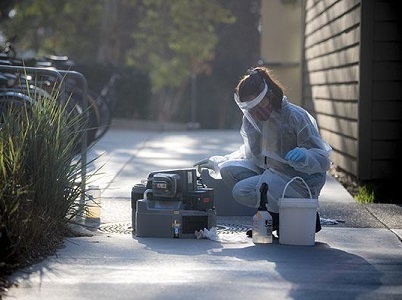
Smruthi Karthikeyan picks up wastewater samples from a collection point on the UC San Diego campus. Credit: Erik Jepsen/UC San Diego
It may feel like years ago, but it was barely one year ago when schools, communities, towns and cities began to shut down because of COVID-19. In the early days, the pandemic was defined by shortages and novelty. There wasn’t enough PPE and there wasn’t a diagnostic test for SARS-CoV-2. Once scientists developed tests, there either weren’t enough to distribute or it was impractical to do so among a large group of people. Because of this, colleges and universities that remained open for in-class learning struggled with how to create a safe environment without testing thousands of students per day.
The University of California San Diego (UCSD) found its answer in wastewater analysis. Researchers have pioneered an automated process that tests city sewage for SARS-CoV-2 so effectively that it allows them to forecast the region's caseload 1 to 2 weeks ahead of clinical diagnostic reports.
This evidence-based approach has allowed UCSD to continue to offer on-campus housing and in-person classes to approximately 10,000 students with a COVID-19 positivity rate of less than 1 percent.
For example, last summer, a positive case was detected in the Revelle College area one Friday afternoon. The campus community was notified within 14 hours and targeted messages were sent to people associated with the affected buildings, recommending they be tested for the virus as soon as possible. More than 650 people were tested for COVID-19 that weekend. As a result, two asymptomatic individuals were identified. After the campus promptly notified them, they self-isolated before an outbreak could occur.
In a paper recently published in mSystems, Rob Knight, director of the Center for Microbiome Innovation at UCSD, and his team detailed the research role they played in the university’s Return to Learn initiative.
San Diego County has only one primary wastewater treatment plant that services all of San Diego's approximately 2.3 million residents, including those on the UC San Diego campus. From July to November 2020, a member of Knight’s team drove to the facility seven days a week to pick up wastewater samples that had been collected and stored by on-site lab technicians.
While the researchers quickly figured out that RNA and PCR were key to identifying the genetic hallmarks of SARS-CoV-2, they also realized that having to concentrate the wastewater before analysis was a bottleneck.
"Unfortunately, we can't just directly test wastewater samples the way we would samples from patient nasal swabs," said Smruthi Karthikeyan, environmental engineer and postdoctoral researcher at UCSD. "The samples we get are highly diluted—just think of the number of people contributing to the waste stream, plus all the junk that gets flushed and makes it to the sewer system."
So, the research team turned to robots. Specifically, they incorporated a nanotrap-based viral concentration method on the KingFisher Flex liquid handling platform (Thermo Fisher Scientific). This allowed all steps from concentrating the samples to real-time qPCR plating to be performed hands-free, minimizing human error and maximizing efficiency. The researchers say the automated liquid handling-based method reduced processing time by at least 20x.
Now, they can process 24 samples every 40 minutes. After analysis, Karthikeyan adds the data to a public digital dashboard that tracks new positive cases, with a special emphasis on identifying the emergence of new variants.
According to the paper, this wastewater analysis method can identify a single COVID-19 case in a building of approximately 500 people. It can also predict positive cases throughout San Diego a week earlier than current methods with excellent accuracy, and three weeks earlier with fair accuracy.
"As the barrier to entry and operate continues to drop, we hope wastewater-based epidemiology will become more widely adopted," Knight said. "Rapid, large-scale infectious disease early alert systems could be particularly useful for community surveillance in vulnerable populations and communities with less access to diagnostic testing and fewer opportunities to distance and isolate—during this pandemic, and the next."