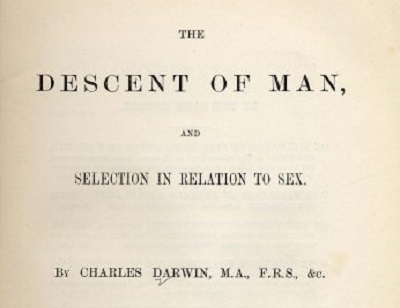
over page of Charles Darwin's “The Descent of Man” (1871).
In a new paper, three scientists argue that, while Charles Darwin may be the father of evolution and modern biology, his lesser-referenced ideas regarding cultural and social evolution have been proven by modern science. Moreover, they believe Darwin’s work has important implications for some of the most pressing problems of modern society.
The research team—comprising a cultural evolutionist, theoretical evolutionary biologist and primatologist—sought to highlight how Charles Darwin’s “The Descent of Man” actually foreshadowed many recent scientific developments in the field. Specifically, they point to three insights from the 1871 publication:
- Humans share many characteristics with our closest relatives—the anthropoid apes—including genetic, developmental, physiological, morphological, cognitive and psychological characteristics
- Humans have a talent for high-level cooperation reinforced by morality and social norms
- Humans have greatly expanded the social learning capacity we see in other primates
In “The Descent of Man,” Darwin wrote, “the difference in mind between man and the higher animals, great as it is, certainly is one of degree and not of kind.” Today, we know that to be true given we share about 96 percent of our DNA with anthropoid apes. Furthermore, studies have continually demonstrated that chimps and apes can undertake physical activities that were once thought unique to humans, such as tool making. The same can be said of emotions, as these mammals have displayed empathy and compassion during behavior studies. While not as heavily researched, the cultural transmission of habits and knowledge in fish, birds and whales is of growing interest to scientists.
“Increasingly, students of animal cognition agree with Darwin that human cognition is continuous with animal cognition. Only one widely recognized difference [between humans and higher animals] remains, which is the human language capacity. Some aspects of language are found in the communication of other species, but not the syntax, recursiveness, and rich meaning of our learned symbolic communication,” the authors write in their paper, published in Science.
Cooperation is seen across all branches of life, from cell organelles to insects like ants and bees, reptiles, mammals and, of course, humans. And although Darwin couldn’t know it at the time, both of our closest primate relatives—bonobos and chimps—are highly cooperative. As the study authors summarize, previous literature has shown the primates engage in exchanges of benefits, including grooming, food sharing and anti-predator defense.
Additionally, Darwin wrote that “besides love and sympathy, animals exhibit other qualities connected with the social instincts which in us would be called moral.” Rooting morality in the emotions, Darwin saw this as an evolved capacity. Indeed, studies have shown many animals—both primate and non-primate—are affected by emotions.
“Since [reports in the 1950s], the study of animal empathy has taken off,” says the research team.
In “The Descent of Man,” Darwin wrote that evolution in civilized societies depends on natural selection only “to a subordinate degree.” He believed culture was particularly important in human evolution, especially when aided by education at a young age, as well as laws, customs and traditions passed down through influential minds and public opinion.
Although Darwin acknowledged the existence of social learning in animals, the study authors say “animal culture” was largely ignored in evolutionary biology until the 2000s. Since then, however, scientists have proven that animals transmit habits and knowledge to each other.
“The first well-known example was sweet-potato washing by Japanese macaques on Koshima island,” write the authors. “Examples range from local bird dialects to nut-cracking with stones by chimpanzees, and from whales’ hunting techniques to pinecone-opening by wild rats. As a result, biologists recognize that vertebrate animal populations possess knowledge reservoirs that are essential for survival and passed on to the next generation through nongenetic means.”
Beyond reinforcing the importance of Darwin’s writings and teachings, the scientists think his insights and perspectives can be applied to the worst of today’s worldwide problems.
“Our society faces challenges, including climate change, inequality, economic crises, political, cultural, and religious conflicts and pandemics. Adequately answering these challenges requires understanding humans’ social behavior and the roles of cooperation, social learning and culture for human decision-making. Evolutionary perspective is already helping to synthesize the contributions of social sciences, including anthropology, psychology, economics, political science and history. The impact of Descent on the social sciences and on the development and implementation of different policies by practitioners and policymakers to improve our society will only grow,” conclude the authors.