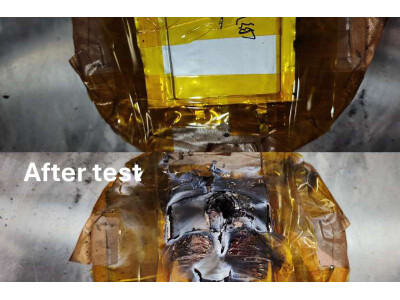
Commercial electrolyte before and after nail test. Credit: Prof. Yi-Chun Lu, The Chinese University of Hong Kong.
Chinese University of Hong Kong researchers have recently introduced a promising new strategy to designing lithium-ion battery electrolytes, which could boost durability of high voltage LiBs while reducing the risk of fires.
Described in the journal Nature Energy, the key to the method was to create an electrolyte which exhibits different behaviors at different temperatures, retaining stability at room temperature yet preventing combustion at high temperatures. to achieve this, the team relied on a mix of two solvents with distinct properties.
"As temperature rises, one solvent effectively 'hands off' the lithium ion to the other—much like a relay race—allowing the electrolyte's structure and reactivity to shift with temperature," said Yi-Chun Lu. "We infused this solvent-relay electrolyte into commercial dry cells and compared them with cells using commercial carbonate-based electrolytes."
To demonstrate the capabilities of the method, the team developed a novel electrolyte that when tested in pouch cells, a widely used type of lithium battery, the cells exhibited excellent performance and thermal stability.
"Our work tackles battery safety from the electrolyte perspective, which we believe holds great practical potential," added Lu. "The electrolyte we developed can be directly infused into existing commercial dry cells without redesigning the battery structure, making it highly compatible with current manufacturing processes. We demonstrated its performance in nickel-rich ternary (NCM) lithium-ion batteries, which are known for their high energy density but also their tendency toward thermal runaway, leading to fire or explosion."
The method developed could soon be used to design other new and promising electrolytes, leading to improved stability and safer LiBs.
"In reality, every component in a battery—the cathode, separator, and anode—plays a crucial role in determining its overall behavior," concluded Lu.
"By tailoring these components, we aim to achieve comprehensive safety without compromising performance. In addition, we are expanding our approach beyond lithium-ion systems to explore sodium-ion and other emerging chemistries, where the same principles of intrinsic safety can be applied.
"Our long-term goal is to establish a general design framework for safe, high-energy batteries across different energy-storage technologies."