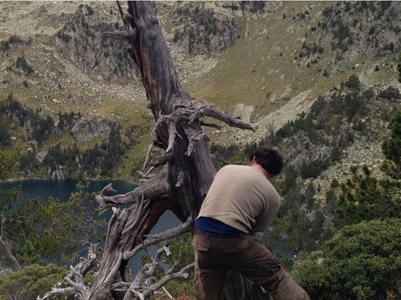
Professor Ulf Büntgen obtaining tree ring samples in the Pyrenees. Credit: University of Cambridge
Clues contained in tree rings have identified mid-14th-century volcanic activity as the first domino to fall in a sequence that led to the Black Death’s reign over Europe. The evidence suggests that a volcanic eruption(s) around 1345 caused annual temperatures to drop for consecutive years due to the haze from volcanic ash and gases, which in turn caused crops to fail across the Mediterranean region. To avoid starvation, Italian city states used their connections to trade with grain producers around the Black Sea. But the ships carrying life-saving food also brought something else with them—the deadly bacterium Yersinia pestis.
For the study, published in Communications Earth & Environment, the researchers were able to approximate the eruption through tree rings from the Spanish Pyrenees, where consecutive “Blue Rings” point to unusually cold and wet summers in 1345, 1346 and 1347 across much of southern Europe. While a single cold year is not uncommon, consecutive cold summers are highly unusual. Documentary evidence from the same period notes unusual cloudiness and dark lunar eclipses, which also suggest volcanic activity.
This volcanically forced climatic downturn led to poor harvests, crop failure and famine. However, the Italian maritime republics of Venice, Genoa and Pisa were able to import grain from the Mongols of the Golden Horde around the Sea of Azov in 1347.
As previous research has established, ships that carried grain from the Black Sea most likely also carried fleas infected with Yersinia pestis. This new research clarifies why grain was so urgently needed by the Italians—to avoid starvation after a volcanic eruption-induced crop failure.
“For more than a century, these powerful Italian city states had established long-distance trade routes across the Mediterranean and the Black Sea, allowing them to activate a highly efficient system to prevent starvation,” said Martin Bauch, a historian of medieval climate and epidemiology from the Leibniz Institute for the History and Culture of Eastern Europe. “Ultimately, these would inadvertently lead to a far bigger catastrophe.”
The researchers say the perfect storm of climate, agricultural, societal and economic factors after 1345 that led to the Black Death can also be considered an early example of the consequences of globalization.
“Although the coincidence of factors that contributed to the Black Death seems rare, the probability of zoonotic diseases emerging under climate change and translating into pandemics is likely to increase in a globalized world,” said Ulf Büntgen from Cambridge’s Department of Geography. “This is especially relevant given our recent experiences with COVID-19.”
The team says resilience to future pandemics requires a holistic approach, including the incorporation of knowledge from historical examples of the interactions between climate, disease and society.
Data from University of Cambridge