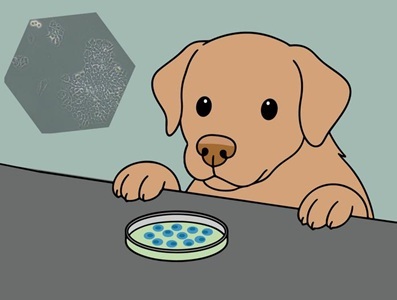
E. coli was used to introduce canine proteins into the medium to act as a scaffold for the stem cells. Credit: Osaka Metropolitan University
Canine induced pluripotent stem (iPS) cells can differentiate into any type of cell, making them practical for investigating both canine and human diseases. Currently, recombinant proteins derived primarily from humans are used as culture substrates for canine iPS cells. However, these human-derived elements are an alien substance for dog cells, often leading to immune rejection.
A research team at Osaka Metropolitan University has solved that problem by engineering E. coli with canine-derived genes to force the bacteria to produce vitronectin (VTN), a dog protein. The E. coli bacteria acted like factories, creating enough VTN to be used as a scaffold to support the growth of canine iPS cells without using any human- or mouse-derived materials.
According to the study published in Regenerative Therapy, the canine-derived VTN supported stem cell culture as effectively as the human-derived version. The stem cells also maintained their full differentiation potential, just as they do in the standard medium.
For potential clinical use, the researchers also evaluated a mutant form, VTN-N, generated by deleting a portion of the protein’s N-terminal region to establish whether trimming down unnecessary or potentially problematic parts of the protein hindered its effectiveness. VTN-N demonstrated similar performance to human-derived VTN, functioning adequately even with a simpler structure.
The team said future studies will enable optimization of the manufacturing process using VTN-N.
Data from Osaka Metropolitan University