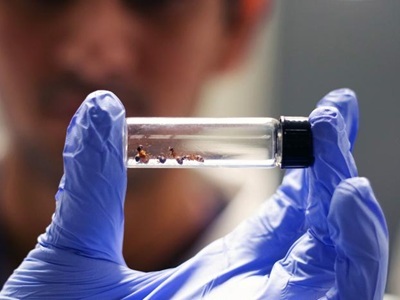
A team of researchers led by Auburn University Assistant Professor Clint Penick studied ants like these, which are easily found in the Southeastern United States. Credit: Luke Edenborough
Humans have relied on antibiotics for less than a century, yet many pathogens have already evolved resistance. Ants, on the other hand, have been using antibiotics for tens of millions of years, yet their chemical defenses remain effective. How?
Trying to answer that question, researchers at Auburn University looked to their backyard. They tested two hypotheses on six ant species—all found easily in the Southeastern United States.
“These are the ants that live in our backyards and live on college campuses,” said study author Clint Penick, assistant professor of entomology at Auburn University. “And yet some of the most powerful antibiotics we found come from ants we typically consider pests, like fire ants.”
In their study, published in the Biological Journal of the Linnean Society, the team tested whether extracts using different solvents showed antimicrobial activity. They found evidence that ants do indeed produce multiple types of antibiotics using different chemical compounds.
The researchers also tested whether ants produce compounds targeted to specific microbes—one of science’s biggest challenges currently.
“If we just dump antibiotics into systems to kill everything, we're not only killing our target pathogen but also killing all these other microbes that aren’t harming us,” said Penick. “By doing that, we're helping breed resistant genes in non-target populations that can lead to drug resistance down the line.”
Again, the team found evidence that ants produce compounds specific to different pathogens: some target fungi, others target gram-negative bacteria, and still others act on gram-positive bacteria.
“This is something that [stakeholders] are really interested in within human medicine—figuring out more targeted antibiotics," Penick said. "It looks like ants have been doing this for millions of years.”
Importantly, Penick and team also found that nearly all of the ant species tested killed a Candida auris, a fatal superbug common in hospitals.
The next step is to look at what types of compounds ants are producing and how they're using them.
“It could help inform our own practices or potentially we could discover new compounds that have medical importance,” Penick said. “Our findings suggest that ants could represent a vast and largely untapped source of new antibiotics, including ones capable of combating today’s most dangerous drug-resistant infections.”