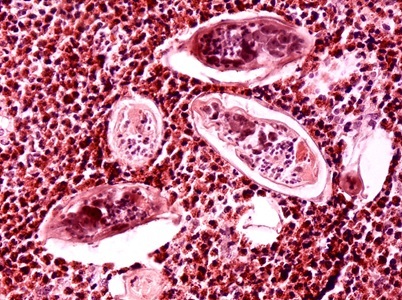
High-powered detailed micrograph of Schistosoma parasite eggs in human bladder tissue. Credit: Dr. Edwin P. Ewing, Jr./CDC
The results of 12 new multidisciplinary studies warn that that hybrid forms of parasites that cause schistosomiasis are undermining disease control strategies and could accelerate the spread of infection in Africa and beyond—including Europe.
Schistosomiasis is a disease caused by waterborne schistosome parasites that affects more than 200 million people worldwide, causing chronic illness, disability and, in severe cases, life-threatening organ damage. Despite decades of large-scale control programs based on mass drug administration, transmission remains persistent in many settings, particularly where people depend on freshwater for daily activities.
Published in a special issue of Philosophical Transactions B of the Royal Society, the studies collectively show that schistosome parasites are hybridizing far more frequently than thought. These hybrid parasites have altered biological traits, including changes linked to virulence, host range and transmission potential. In turn, these changes complicate diagnosis as hybrid eggs can be harder to identify using standard methods, and raise concerns that current control strategies—which largely focus on treating human infection alone—may be missing key reservoirs of disease.
The studies show that hybridization is driving the emergence of new variants in both northern and southern Africa, each responding differently to ecological and agricultural pressures. One hybrid variant, Schistosoma haematobium x S. mattheei, which links a human-infecting species with a livestock species, is now a common cause of genital tract disease in men and women in parts of Malawi.
But it’s not just Africa. While several study authors note that hybrids are already reshaping patterns of schistosomiasis across Africa, they also warn that this extensive of an outbreak could establish disease in new regions. For example, previous outbreaks of urogenital schistosomiasis in southern Europe have shown that transmission outside Africa is possible when animal and human parasites overlap.
“Schistosomes are demonstrating parasite evolution in action with remarkable speed,” said senior author Russell Stothard of the Liverpool School of Tropical Medicine. “This new body of work reveals a level of biological complexity and flexibility that changes how we appreciate schistosomes, classify them and hope to mitigate their detrimental impact.”
Together, the authors say that without improved surveillance, including genetic monitoring of parasites, and greater integration of human, animal and environmental health strategies, hybrid schistosomes could slow or reverse progress toward elimination targets.
The scientists call for a One Health approach, which considers humans, animals and the environment to address the full spectrum of disease control—from prevention to detection, preparedness, response and management. The approach is based on the idea that the health of humans, domestic and wild animals, plants and the wider environment are closely linked and interdependent. This collaboration across sectors and disciplines then contributes to protecting health, addressing challenges like antibiotic resistance and infectious disease control, and promoting the integrity of ecosystems.
“Hybrid schistosomes are not unusual biological outliers, they are becoming a central part of the epidemiological landscape. This raises important questions for future disease surveillance and associated treatment strategies that should better embrace One Health approaches,” concluded Stothard.