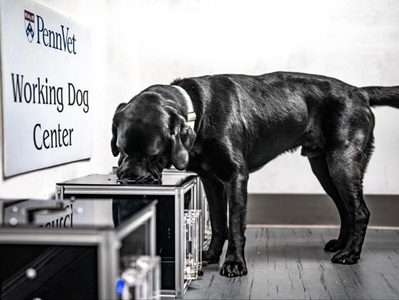
Dalton at the olfactometer lineup. Credit: Shelby Wise
Studies suggest that about 40 percent of all dogs will develop cancer during their lifetime.
Hemangiosarcoma—an aggressive, malignant cancer of blood vessel cells—can be especially devastating. Often not diagnosed until a seemingly healthy dog collapses, it has been described as a “silent killer.” Currently, there are no diagnostic measures or tools to detect it early, and the prognosis once diagnosed is poor.
In a new study, researchers at the University of Pennsylvania evaluated whether hemangiosarcoma has a distinct “signature” scent or pattern of volatile organic compounds that dogs can detect.
Five bio-detection dogs previously trained to recognize odors associated with other diseases, including chronic wasting disease, post-traumatic stress disorder, human ovarian cancer, and human pancreatic cancer, participated in double-blinded tests that included blood serum samples from dogs with confirmed hemangiosarcoma, dogs with non-cancerous diseases other than hemangiosarcoma (diseased controls), and healthy controls. Each dog evaluated 12 matched sample sets across seven trials per set. Notably, none of the samples had been used during the initial training sessions.
According to the study results, published in The Veterinary Journal, the dogs correctly identified the hemangiosarcoma samples 70% of the time—similar to the percentage seen in studies of dogs detecting human cancer.
Critically, the results indicate that hemangiosarcoma does have a detectable scent profile, Now, research could be put into developing a machine or a test to detect it. The researchers say a scent test could even potentially be used as an annual screening.
“It could flag a potential issue so that the owner could get further testing, such as ultrasound or CT scans,” said Clara Wilson, a postdoctoral research fellow at Penn Vet’s Working Dog Center. “It could really help catch it early for these dogs where we're just finding it far too late.”
Data from University of Pennsylvania