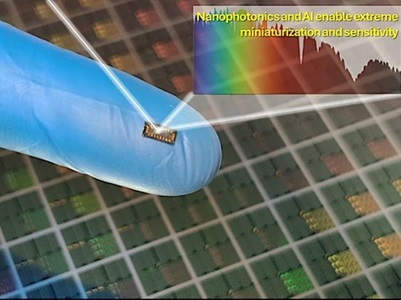
Resting on a fingertip, this miniature sensor replaces bulky laboratory equipment by using photon-trapping surface nanostructures and artificial intelligence (AI) to accurately analyze disease, check food quality, and detect pollution, using both visible and near-infrared light. Credit: Integrated Nanodevices & Nanosystems Research Lab at UC Davis
A recent study from the University of California, Davis tackles the challenge of miniaturization, aiming to shrink a lab-grade spectrometer down to the size of a grain of sand—in other words, a spectrometer-on-a-chip that can be integrated into portable devices.
Instead of physically separating each color like a traditional spectrometer, the new chip uses 16 distinct silicon detectors, each engineered to respond slightly differently to incoming light. The key to this innovation lies in two technological breakthroughs, according to the paper published in Advanced Photonics.
First, the team engineered the surfaces of standard silicon photodiodes with specialized photon-trapping surface textures (PTSTs). Silicon is typically effective at sensing visible light but is poor at sensing near-infrared (NIR) light (wavelengths up to 1100 nm)—which is critical for many applications, like biomedical imaging—because it penetrates human tissue more deeply than visible light. The PTST surface acts like a cleverly designed texture that forces NIR photons to scatter within the thin silicon layer instead of passing straight through. This dramatically increases the likelihood that the silicon absorbs light, making the entire chip sensitive across a broad spectral range.
Second, the chip uses a powerful fully connected neural network (AI). Since the 16 unique detectors only capture encoded, noisy signals, the AI is trained on thousands of examples to learn the complex, hidden relationship between the detectors' raw outputs and the original, pure light spectrum. The AI addresses this inverse problem, reconstructing the light spectrum with high accuracy. This computational method completely removes the need for bulky optics. The AI-augmented chip can maintain signal clarity even in the presence of significant electrical interference, a major challenge in portable, low-cost electronics.
The final result is a system with a minimal footprint (0.4 square mm), high sensitivity, and strong noise resistance.
Data from SPIE