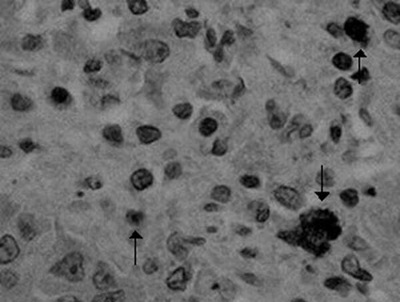
Immunohistochemical detection of en:canine coronavirus antigen (arrows) in canine lung tissue by a specific en:monoclonal antibody (magnification ×400). Credit: CDC
In a new article, researchers across multiple states have issued a stark warning: conditions are ripe for two emergent respiratory viruses with animal origins to spread widely among humans.
“If we wish to avoid being fooled again by a novel virus suddenly gaining efficient human-to-human transmissibility and causing large human epidemics, we would be wise to develop better surveillance systems and new countermeasures for these and similar viruses,” the authors write in Emerging Infectious Diseases, a journal of the Centers for Disease Control and Prevention.
The two viruses of concern are influenza D—which primarily affects cows and pigs, but also many other livestock and wildlife—and canine coronavirus, which causes gastrointestinal illness in dogs and has been linked to pneumonia hospitalizations in humans.
Influenza D
Initially thought to be enzootic in pigs and cattle, influenza D has now been detected in camels, deer, giraffes, kangaroos, llamas, wallabies and wildebeests. Most recently, scientists have found evidence of infection in poultry, as well. The team of scientists from universities in Texas, Ohio, Florida and Kentucky say the ever-growing list of susceptible hosts is similar to those observed with the highly pathogenic avian influenza A(H5N1) viruses. This also suggests that influenza D is capable of rapidly evolving.
Although no influenza D infections have been isolated from humans thus far, mounting evidence indicates that the virus is zoonotic and causes subclinical infections in humans.
In 2016, the article authors published a study that showed over 97% of cattle workers in Florida had neutralizing antibodies to influenza D, compared with only 18% among a control population not exposed to cattle. In 2023, the team worked with 31 dairy workers in Colorado, taking nasal wash samples during a 5-day period. The scientists found molecular evidence of influenza D in 67% of the workers.
Recently, a different team found that 73% (97% among those with respiratory symptoms) of 612 study participants in northeast China had serologic evidence of infection. They documented viral transmission in the air between ferrets, replication in primary human epithelial cells and infection in mice and dog models. This led them to conclude that influenza D has acquired the capacity for human-to-human transmission and some strains already pose a potential panzootic threat. This study is the first serologic evidence of influenza D infection in a general human population, providing a theoretical framework for expected virus growth and human-to-human spread.
Canine coronavirus
In a 2017 study involving one of the new paper authors, researchers isolated a canine coronavirus from a medical team member who had traveled from Florida to Haiti in 2017 and later experienced mild fever and malaise. They named the strain HuCCoV_Z19Haiti.
In 2021, researchers at the University of Texas Medical Branch reported the discovery of a new canine coronavirus strain—CCoV-HuPn-2018. The strain was isolated from a child hospitalized in Malaysia and was nearly identical to the coronavirus discovered in 2017. A subsequent analysis from individuals visiting Haiti indicated the same strain again.
Most recently, the paper authors detected CCoV-HuPN-2018 in 18 of 200 pneumonia patients hospitalized in Vietnam.
“Earlier clades of CCoV-HuPn-2018 might have not yet evolved to be an efficient human pathogen, but they may be evolving now, as evidenced by the increased number of patients affected by the virus in the study by our surveillance team in Vietnam,” explained the article authors.
Additionally, animal alphacoronaviruses have been detected among humans with respiratory illness living in Bangkok, Thailand, and the U.S. state of Arkansas—officially confirming the circulation of the strain among wide geographic regions.
Better diagnostics and surveillance needed
The research team is especially concerned as canine coronavirus is missed by common clinical diagnostics tests for the detection of respiratory viruses. In fact, the scientists say diagnostics and surveillance for both influenza D and canine coronavirus are overall lacking.
“Our review of the literature indicates these two viruses pose respiratory disease threats to humans, yet little has been done to respond to or prevent infection from these viruses,” said article co-author John Lednicky, who led the 2017 study that identified HuCCoV_Z19Haiti. “Our knowledge about the viruses’ epidemiology and clinical manifestations are limited to a modest number of research studies. Even so, the limited data regarding these novel, newly detected viruses indicate that that they are a major threat to public health.”
To prevent another COVID-19 scenario, Lednicky and collaborators suggest the development of commercial real-time reverse transcription PCR diagnostic tests specifically targeting influenza D and CCoV-HuPN-2018 viruses. They also suggest clinicians consider these viruses in their workup of pneumonia patients when common tests fail to identify a pathogen. Lastly on the diagnostic side, the researchers say scientists should begin evaluating antiviral drugs as effective therapy for the treatment of influenza D and canine coronavirus.
On the surveillance front, the authors say surveillance should be strategically focused at the human–animal nexus where risk is particularly high.
Specifically, the team argues that periodic surveillance with targeted and pan-species diagnostics would be prudent for viruses in six viral families—adenoviridae, eoronaviridae, orthomyxoviridae, paramyxoviridae, picornaviridae, and pneumoviridae.
“Conducting such surveillance in concert with occasional agnostic next-generation sequencing of specimens associated with unusual illnesses can help us better prepare for future pandemic threats at more sustainable costs than previous strategies that sought to detect novel pathogens in many wildlife hosts,” conclude the article authors.