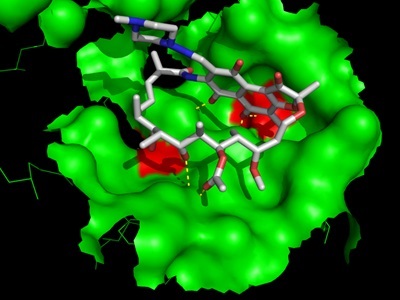
Rifampicin bound to bacterial RNA polymerase. The enzyme surface is shown in green. The two residues which are observed to mutate in resistant strains are shown in red. Credit: F Dardel
Every time a patient is treated with antibiotics, it increases the risk of bacteria gaining antibiotic-resistance. But sometimes these antibiotics are necessary to treat infection, so it becomes a double-edged sword.
Now, scientists have designed “nano-agents” that can carry drugs straight to the infected area, providing localized therapy with minimal amounts of drug thereby reducing the risks of antibiotic resistance.
Many bacterial infections form biofilms—sticky, protective layers that make them hard to treat. Biofilms resist many antibiotics because drugs cannot easily penetrate their thick structure. Water-repelling antibiotics are especially ineffective because they struggle to get deep inside these moist, gel-like biofilms.
For this study, published in JACS Au, researchers designed particles to hide the antibiotic rifampicin, which is used to treat tuberculosis and Staphylococcus aureus infections, including those associated with medical implants.
The results showed that a low frequency ultrasound helps the nanoparticles move deeper into the biofilm. It also causes tiny bubbles that shake the drug loose from the particles at just the right time.
Staphylococcus aureus biofilms treated with nanoparticles combined with ultrasound killed 90% of the biofilm. Without ultrasound, they achieved only 20% reduction, while treatment with free rifampicin and LFUS resulted only in a 10 % reduction. Without ultrasound, the nanoparticles only reached the top 1.6 μm of the biofilm, but with ultrasound they reached 5.6 μm—nearly the entire thickness.
The “nano-agents” are tiny silica particles designed with a water repelling inner core to hold the drug and a ‘water-loving’ outer shell so that they remain stable in biological environments. Researchers also made a fluorescent version of the particles by adding dye so they could track them inside the biofilms, supporting the localized delivery of the drug and penetration depth.
“We’ve found a new way to deliver difficult antibiotics more effectively, using an approach that could be adapted for other hard-to-deliver drugs, potentially including cancer therapies,” said study author Zoe Pikramenou from the University of Birmingham. “Biofilm infections are common in wounds, implants and medical devices. This approach allows hard-to-reach areas to be treated.”
Data from University of Birmingham