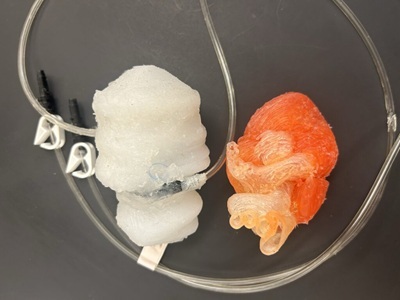
Two 3D-printed heart models. The white one replicates the left two heart chambers with a pneumatic actuator that makes it “beat.” Credit: WSU
Washington State University researchers have developed a 3D-printed model of the left side of the heart that contracts and beats, offering the chance for surgeons and medical students to rehearse important heart surgeries on a model that acts like the real thing.
“It’s very useful for doctors and surgeons to practice when the heart is still beating, especially for minimally invasive surgery,” said corresponding author Kaiyan Qiu, professor, Washington State University. “In our case, this model is the first fully synthetic model that, without any assistance of animal models, mimics the complete left side of the heart. We were able to incorporate both the anatomic features and the dynamic functions.”
In their work, published in Advanced Materials Technologies, the researchers used a scan of a real heart to 3D print a replica of the left side of the heart. The left side of the heart experiences the highest pressures and performs the heart’s most vital functions, pumping oxygenated blood throughout the body. As people age, the mitral valve between the two left heart chambers often gets leaky, so that blood flows backward, or regurgitates, and reduces the heart’s efficiency.
The heart model the researchers made includes the atrium, ventricle and mitral valve and has a soft texture similar a real heart. It also has multiple tiny pneumatic actuators that pump the model and string-like material similar to a real heart that manages the mitral valve movement. As imitation blood is pumped through the model, sensors on the model can monitor “blood pressure.”
After creating the model, the researchers printed a defective mitral valve and then repaired it. They created a repair device similar to commercially available devices and inserted it into the mitral valve. Sensors on the model showed increased blood pressure in the left ventricle, indicating that the valve was fully closing. They also could see with ultrasound imaging that their imitation blood was not regurgitating into the heart chamber.
The researchers have filed a provisional patent and are now working to develop a complete heart model with all four chambers and four valves. They also plan to work with medical professionals and students in the future to conduct more patient-specific, pre-surgical rehearsals on the model for different valve diseases.
Data from Washington State University