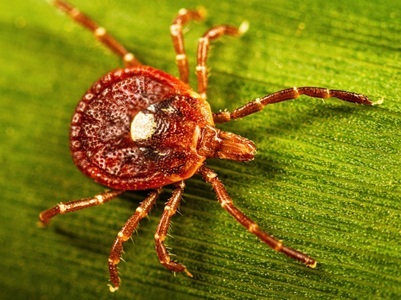
The lone star tick (Amblyomma americanum) is widely distributed in the Northeast, South, and Midwest United States. Credit: CDC
A new study is the first to confirm that some ticks can survive indoors for any length of time. Specifically, two species of ticks can live at least one week but up to about three weeks on hard-surface and carpeted floors after they hitch a ride inside on people or pets.
For the study, published in Journal of Vector Ecology, researchers tested the survival time of 90 ticks from the lone star and Gulf Coast species. Survival rates were assessed in three rounds of experiments in five types of common home flooring: tile, wood, vinyl, and short-pile and shag-like carpet. Ticks were individually covered with a cup so they couldn’t escape, but they could move around. Two rounds of the experiments compared survival to control ticks kept in a growth chamber to confirm experimental tick deaths were related to the flooring conditions.
First author Afsoon Sabet, a PhD student in entomology at Ohio State, monitored the ticks daily, with a few exceptions, completing over 4,600 individual observations.
The average overall survival time of Gulf Coast ticks was about 18 days, 11 days for lone star ticks. The longest survival time for Gulf Coast ticks was an average of 25 days on vinyl and the shortest was 10 days on long-pile carpet. Average survival time of lone star ticks was the longest, almost 15 days, on long-pile carpet and shortest on tile—about 7 days.
The cause of death was presumed to be desiccation, or loss of moisture. Meanwhile, some of the control ticks kept at ideal temperatures and humidity levels in the lab survived for more than a year.
“Pinpointing exactly how long a tick might survive in a home is really difficult because people’s homes are going to vary in their environmental conditions. But for the first time, this study puts some guardrails on that estimate, and it shows us that ticks can survive for at least a week,” said co-senior author Risa Pesapane, associate professor of veterinary preventive medicine at Ohio State.
Data from Ohio State University