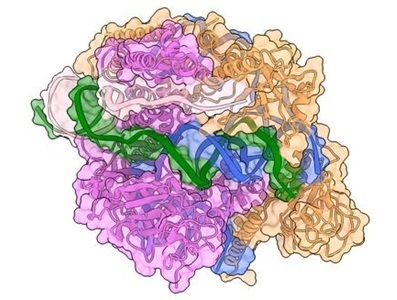
Protein structure of Al3Cas12f, a kind of CIRSPR-based molecular scissors developed by a team from the University of Texas at Austin. Credit: University of Texas at Austin
Researchers have developed a smaller pair of “molecular scissors” for gene editing that could make site-specific delivery within the body possible.
In the new study, scientists at biotech company Metagenomi identified a tiny, naturally occurring bacterial nuclease enzyme, Al3Cas12f, capable of highly efficient editing. It surpassed two other Cas12f enzymes that researchers recently deployed via AAV to modify muscular dystrophy-associated genes in mice.
Using cryo-electron microscopy and machine learning tools to build models that simulated the nuclease’s structure and function as it forms and interacts with DNA, the study authors discovered that Al3Cas12f exhibits an extra-large interface between all of its components—allowing for a more secure connection.
“The expanded interface means the enzyme is much more stable. Compared with the others we looked at, Al3Cas12f basically comes preassembled and ready to go shortly after its pieces are produced,” said David Taylor, a UT molecular biosciences professor and study co-author.
While a sturdier molecular machine, the nuclease still struggled to edit some genes that the researchers targeted. Having analyzed the nuclease inside and out, the authors began to tinker with its makeup. Of the many variants they produced, one known as Al3Cas12f RKK stood above the rest.
The team introduced instructions for RKK directly into a line of human cells originally isolated from a patient with leukemia. Mutations in several of the genes they aimed to edit were associated with diseases such as cancer, atherosclerosis and amyotrophic lateral sclerosis (ALS). The researchers saw that, across the tested targets, RKK improved on the original’s editing efficiency of less than 10% to more than 80%.
The authors expect to build on these results. Next, they plan to conduct tests of the nuclease’s performance when packaged into AAV vectors, which, if successful, could bring gene-editing therapy for many diseases much closer to reality.
Data from University of Texas at Austin