Credit: Mass General Brigham
New research indicates estimating biological age from multiple photos taken over time can provide more information about how well a person with cancer will do with treatment. The results suggest that Face Aging Rate (FAR)—which uses photos to measure changes in biological age over time—can serve as a non-invasive biomarker for cancer prognosis.
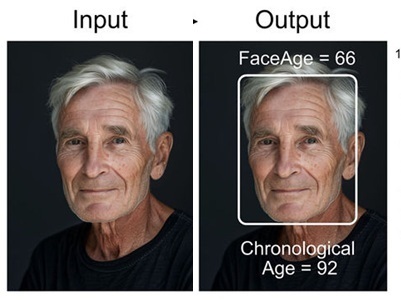
The research is based on FaceAge, an AI tool that uses deep learning technologies to determine biological age from a person’s face photo.
In the new study, published in Nature Communications, the researchers sought to learn what information FaceAge could provide when applied to multiple photos of the same person taken over time. They inspected facial photos of 2,279 patients with cancer who received at least two courses of radiation therapy at Brigham and Women’s Hospital between 2012 and 2023. The photos were taken as part of the routine clinical workflow at each separate radiation therapy course. FAR was calculated as the change in FaceAge between these two time points, divided by the time interval. The researchers also calculated FaceAge Deviation (FAD), which estimates how biologically old or young the patient looked in a single face photo relative to chronological age.
Median FAR results indicated that patients' facial aging outpaced their chronological aging by 40%. Higher FAR, or accelerated aging, was associated with lower survival, and the effect was strongest when the interval between photos was two years or more.
Additionally, patients with both high FAD and FAR values were significantly more likely to have poorer survival probabilities. However, FAR was more likely to predict survival outcomes stably over longer intervals than FAD—indicating that dynamic measurements might be more reliable than single timepoint readings. The authors suggest that integrating FAR with baseline FAD could provide a more nuanced and informative measure of an individual’s evolving health status.
In another recent study published in JNCI: Journal of the National Cancer Institute, FaceAge was tested on more than 24,500 cancer patients over the age of 60 who received radiation therapy. FaceAge was older than chronological age in 65% of the patients. Those with a FaceAge estimate 10 or more years older than their chronological age had significantly worse survival outcomes, while those with an estimate of five or fewer years had better outcomes.
Ongoing and future studies, including prospective trials, will continue to investigate FaceAge outcomes in patients with different cancers and other diseases. The research team has now also launched an institutional review board-approved web portal that allows the general public to submit their own face photographs to get a FaceAge assessment and participate in research to advance this technology at faceage.bwh.harvard.edu.
Data from Mass General Brigham