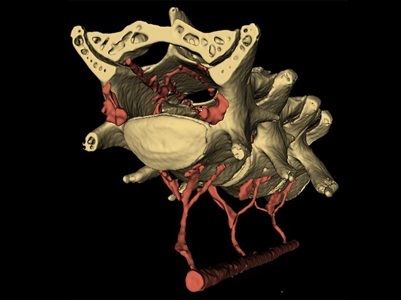
Using microCT scanning, which allows for high-resolution imaging of an organism's internal structures, and other imaging techniques, researchers found that a network of veins serve as a mechanical connection between the abdominal cavity and the brain. Here, the veins in red run through the interior of a vertebrae and around the spine. Credit: Penn State
A new study has identified a potential biological mechanism underlying why exercise is thought to benefit brain health: abdominal contractions compress blood vessels connected to the spinal cord and the brain, enabling the organ to gently move within the skull. This swaying facilitates the surrounding cerebrospinal fluid to flow over the brain, potentially washing away neural waste that could cause problems for brain function.
The researchers visualized the process in mice using two-photon microscopy and microcomputed tomography. They observed the brain shifting in the moments before the mouse moved, but right after the tightening of the abdominal muscles needed to spur the body into further movement.
To confirm that it was abdominal contractions rather than other movement that acted as the pump, the researchers applied gentle and controlled pressure to the abdomens of lightly anesthetized mice. With no other movement other than a localized mechanical pressure less than a human would experience with a blood pressure cuff, the mice’s brains shifted.
With the abdominal contraction-brain movement link confirmed, the next step was to understand the fluid’s movement in the brain and if the brain’s movement could induce fluid flow. However, there were no existing imaging techniques to visualize this dynamic so one had to be developed at first.
The key, the researchers say, was simplifying the geometry of the brain to that of a sponge. The team could then model how fluid flows through a structure with varied spaces, like wrinkles in the brain or pores in the sponge.
While more work is needed to understand the full implications in humans, this study suggests that body movement may help to cycle cerebrospinal fluid around and in the brain, removing waste and helping to protect against neurodegenerative disorders associated with waste buildup.
Data from Penn State