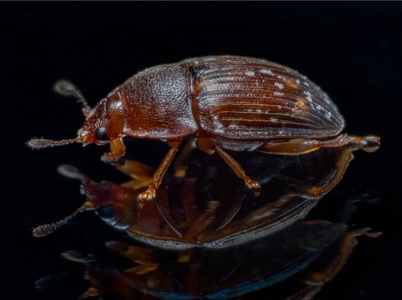
The strawberry sap beetle is one of two invasive beetle species found to serve as vectors for the newly described nematode species Caenorhabditis apta. © Gustavo Alarcon-Nieto / Genes and Behavior Group
In 2025, scientists in Konstanz, Germany looked very closely at rotting fruit in local orchards, and observed what no one had before—worms, hundreds of them, twisting skyward into self-assembled living structures known as “towers.” It was the first time anybody had seen this mysterious behavior outside of the laboratory.
Back in the lab, the German team showed how these towers could attach to fruit flies, supporting a long-standing idea: towering worms may be trying to hitchhike on animals to reach new habitats. While the lab experiments confirmed that towers can latch onto potential carriers, it remained unclear which animals actually transported these worm stowaways in the wild.
Now, the team—from Max Planck Institute—believes they have identified the carriers of the original worm towers: two sap-feeding beetles, both invasive crop pests in Europe. While the researchers did not directly observe worm towers attaching to the beetles, they surveyed several hundred invertebrates from orchard fruit and found dense clusters of the worms exclusively on these beetles. Genetic analysis revealed that the worms forming the original towers belong to a previously undescribed species, which the researchers named Caenorhabditis apta.
After discovering the relationship between C. apta and the beetles, the team began to wonder whether this association might extend beyond German orchards. The newly described nematode had only been recorded in European collections since 2010, while both beetle species arrived in Europe in the early 2000s, one from North America and the other from the western Pacific.
This raised a possibility: What if C. apta hitched a ride into Europe on the wings of the beetles?
To explore this, the Max Planck team compared global records of the two beetles with collections of C. apta and its closest relatives. They found overlapping distributions with one of the beetle species—the strawberry sap beetle—in North America, pointing to a possible route by which C. apta reached Europe.
If C. apta is a recent arrival, its interactions with native European species could already be driving ecological and evolutionary changes, altering food webs and the processes of fruit decomposition in orchard ecosystems, the scientists say.
The research team is now looking to see if C. apta hitchhikers might benefit, or even hinder, their beetle vectors.
Data from Max Planck Institute of Animal Behavior