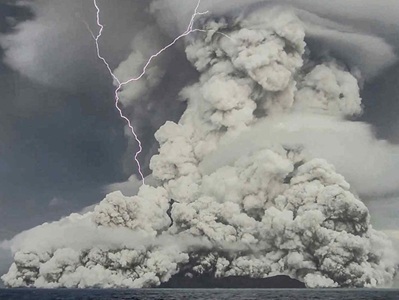
The Hunga Tonga–Hunga Ha'apai-volcanic eruption on 15 january 2022. Image taken from a video of the eruption. Credit: Tonga Geological Services via University of Copenhagen
When the submarine volcano Hunga Tonga–Hunga Ha’apai in the South Pacific erupted in January 2022, it was one of the most violent volcanic eruptions in modern times. But then the volcano did something unexpected: it helped clean up some of the methane pollution it released.
According to the researchers, everything points to a very special process taking place—one they first discovered in 2023, but in a completely different part of the world. They found that when dust from the Sahara is blown over the Atlantic Ocean, it mixes with sea salt from sea spray, forming small particles known as iron salt aerosols. When sunlight hits these aerosols, chlorine atoms are produced. These chlorine atoms react with methane and help break it down in the atmosphere. This discovery changed scientific understanding of tropospheric chemistry.
“What is new—and completely surprising—is that the same mechanism appears to occur in a volcanic plume high up in the stratosphere, where the physical conditions are entirely different,” said Matthew Johnson from the University of Copenhagen, one of the researchers behind both discoveries.
The 2022 eruption hurled enormous amounts of salty seawater into the stratosphere along with volcanic ash. The theory is that when sunlight hit this mixture, highly reactive chlorine was formed, helping to break down the methane released during the eruption. The visible evidence of this methane breakdown was the large amounts of formaldehyde detected in satellite images.
The research was conducted with the advanced TROPOMI instrument aboard the European Space Agency’s Sentinel-5P satellite, which monitors air pollution and greenhouse gases worldwide on a daily basis.
The researchers believe the new findings will inspire engineers in industry.
“It’s an obvious idea for industry to try to replicate this natural phenomenon—but only if it can be proven to be safe and effective. Our satellite method could offer a way to help figure out how humans might slow global warming,” said Johnson.
Data from University of Copenhagen