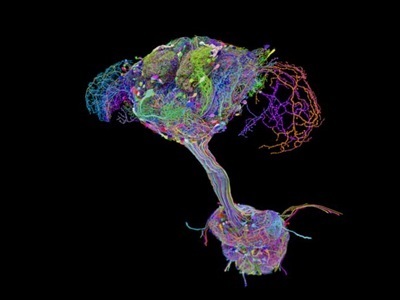
The connectome maps how neurons in the fruit fly brain connect to those in its body via its spinal cord equivalent. Credit: Tyler Sloan
In a first, a multi-laboratory team has published a complete wiring diagram—known as a connectome— of all the connections between neurons in the central nervous system of an adult fruit fly. This work allows researchers to begin to study how the brain and body interact to carry out complex behaviors, such as walking and flying. It also empowers deeper investigations into the basic principles of how nervous systems work.
To build the connectome, the team created thousands of thin, serial sections of a single fruit fly, which they imaged with electron microscopy to produce millions of images of neurons and neural connections. They then used AI tools to align the images and stitch them into a cohesive 3D map.
The connectome shows how each individual neuron connects to every other neuron in the brain and nerve cord at the synapse level. Although the map doesn’t span the fly’s entire body, the team was able to use identifiable neurons and the scientific literature to connect the neurons in the central nervous system to those in many of its appendages and sensory organs, effectively “embodying” the connectome.
Researchers can use the connectome to form new hypotheses to test in the lab. For example, one longstanding idea in neuroscience is that a centralized controller in the brain is responsible for making decisions about the actions an animal will perform. However, using the connectome, the researchers discovered that motor control in the fruit fly mostly happens at a local level.
A big question, the researchers say, is whether the distributed control of neural circuits they saw in the flies occurs in other species—something they now investigating in mice.
“I would be shocked if this is unique to the fly,” said co-first author Helen Yang, a research fellow in neurobiology at Harvard Medical School. “We don't have this level of resolution in other animals, but we know that they have a lot of these local circuits.”
In the near future, the team plans to add more information to the connectome, including regarding neuropeptides—the small, protein-like molecules that neurons use to communicate. Another goal is to bring full-connectome mapping to much more complex organisms.
The researchers see endless future directions for research using their connectome. Yang draws an analogy to the Human Genome Project, another large-scale, open-source resource that has had a wide range of applications.
The entire connectome is freely available online.
Data from Harvard Medical School