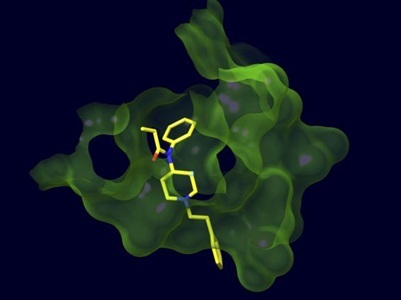
Fentanyl (yellow structure) and the antibody's binding pocket (green structure)—showing how the antibody recognizes the overall shape of the new molecule, rather than one particular scaffold. Credit: Scripps Research
The opioid crisis in the United States is long-running. Beginning in the late 1990s, an overprescription of medications like oxycodone and hydrocodone triggered a surge in addiction. As prescription drugs became harder and more expensive to obtain, many users transitioned to cheaper heroin starting around 2010. Since 2013, the crisis has been overwhelmingly driven by illicitly manufactured fentanyl, which is up to 50 times stronger than heroin and is frequently mixed into other drugs or pressed into counterfeit pills.
Forensic and laboratory scientists have been trying to get ahead of the screening and detection curve for years, but drug makers have been making it nearly impossible by constantly cooking up slightly modified versions of fentanyl and other drugs to avoid detection in standard screenings. This puts scientists at a constant disadvantage as mass spectrometry reference data cannot keep pace with every new synthetic designer drug that hits the black market.
“We need countermeasures that are going to work against all these future variants at once, not just one at a time,” said Kim Janda, professor of chemistry at Scripps Research.
In new research, Janda and her team made critical progress toward a vaccine candidate that could work against the entire fentanyl class—not just individual structures.
From Narcan to vaccine
While existing interventions like Narcan can reverse an overdose, the medicine typically only works within a short time period. Additionally, as synthetic designer drugs continue to evolve, multiple doses of Narcan are needed to revive an individual.
Janda’s team is exploring the possibility of a vaccine combat fentanyl deaths. Recently, they created a modified version of fentanyl that retained its pain-relieving properties while eliminating many of its dangerous side effects. Leaning into those results, the researchers tested whether a similar molecule—which had a core structure different from fentanyl but includes some similar components—could be used as a vaccine candidate.
In the new study, published in the Journal of Medicinal Chemistry, researchers attached the modified fentanyl to a carrier protein and used it to vaccinate mice in four doses over eight weeks. The results revealed a surprise: the immune system didn’t need an exact structural match to generate antibodies against fentanyl. Instead, it recognized a general molecular fingerprint shared across the entire fentanyl drug class.
When the team tested the resulting antibodies against different fentanyl designer drugs, the vaccine showed exactly the kind of pan specificity they had been looking for. The antibodies bound tightly to fentanyl and other dangerous variants—including carfentanil, China White, acetylfentanyl and furanylfentanyl. Yet, they ignored clinically used opioids like morphine, oxycodone, remifentanil and alfentanil.
More importantly, when vaccinated mice were given fentanyl doses that would normally cause severe respiratory depression, the animals’ breathing remained nearly normal. Measurements of fentanyl concentration in the brain showed that the vaccine had reduced levels there by roughly 70% compared with mice that didn’t receive the vaccine.
Clinical trials are still needed to test the safety and efficacy of the vaccine in humans, but Janda says the platform could potentially be used to prevent overdoses in people in substance abuse recovery programs or others at high risk of fentanyl exposure.
“The public health potential here is significant,” says Janda. “But so is the lesson that we can design vaccines that recognize an entire drug class, not just a singular drug. What this research shows us is that we don’t have to keep playing catch-up with every new synthetic designer drug that emerges.”