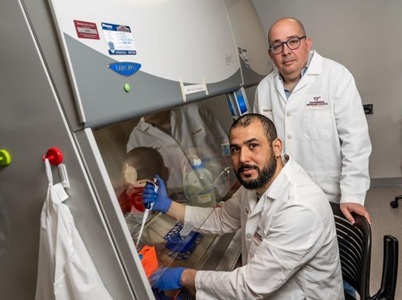
Yassine Sassi (standing), associate professor at the Fralin Biomedical Research Institute at VTC, and Aymen Halouani, first author of the study, identified BMP3 as a promising new therapeutic target for pulmonary arterial hypertension. Credit: Clayton Metz/Virginia Tech
Researchers have discovered that increasing the expression of a natural protective protein in preclinical models of pulmonary arterial hypertension can reverse key features of the disease, including pulmonary vascular remodeling and heart dysfunction.
For the study in the European Respiratory Journal, researchers used two different methods to increase bone morphogenetic protein 3, or BMP3, levels. Both methods reversed key features of the disease, including damaged blood vessels and impaired heart function.
According to the study results, BMP3 is produced by cells in the walls of lung blood vessels. In healthy lungs, BMP3 helps keep blood vessel cells from growing and spreading too aggressively. But in pulmonary arterial hypertension, BMP3 levels fall. Without enough BMP3, blood vessels begin to thicken and narrow, restricting blood flow through the lungs. The researchers found that BMP3 levels were consistently reduced in lung tissue and blood samples from patients with pulmonary arterial hypertension, as well as in experimental models of the disease.
To test whether restoring BMP3 could counteract disease progression, the researchers used both recombinant BMP3 protein and a lung-targeted gene therapy approach designed to increase BMP3 expression. Both strategies significantly reduced disease severity in multiple preclinical models, improving pulmonary vascular structure and cardiac function.
“This gives us two potential therapeutic paths forward: a biologic therapy and a gene-based approach, both designed to restore a natural protective signal that is lost during disease,” said senior author Yassine Sassi, associate professor at Virginia Tech.
While additional studies are needed before the approach can be evaluated in patients, the findings identify BMP3 as a promising therapeutic target for a disease in which no currently approved therapy reverses the underlying vascular remodeling.
Sassi and first author Aymen Halouani of the Fralin Biomedical Research Institute have filed a patent application covering BMP3-based therapeutic approaches for pulmonary arterial hypertension.
Data from Virginia Tech