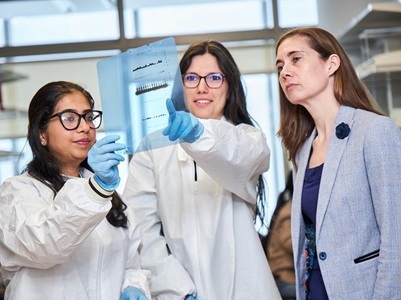
Katherine Aird with members of her lab. Credit: The Wistar Institute
Some cancer cells survive chemotherapy but stop dividing. Scientists have long assumed these dormant cells were mostly harmless leftovers. However, a new study from The Wistar Institute suggests otherwise: these cells stay biologically active, releasing molecules that help neighboring tumor cells spread.
The “leftover” cells do this by employing fructose as a key messenger in this process, a new finding that has revealed a previously unrecognized way cancer can spread after successful treatment.
Ovarian cancer is treated almost universally with platinum-based chemotherapy, and most patients respond well at first. But the disease has a high return rate, and when it does, it almost always spreads through the abdominal cavity. Researchers have long suspected that chemotherapy-surviving cells contribute to this recurrence, but it has never been proven.
To test the idea, Aidan Cole, a postdoctoral fellow at The Wistar Institute, and colleagues designed a unique experiment: they collected and analyzed the molecules released by chemotherapy-surviving cells. The researchers found that the molecules alone—without any accompanying cancer cells—were enough to significantly increase the spread of cancer in a preclinical model.
“As far as we know, this is the first time anyone has shown, in a preclinical model rather than just a dish, that it’s the molecules these cells release—not the cells themselves—that drive the cancer’s spread,” said Cole.
The distinction Cole identified in the molecules matters: it points to secreted signals, not surviving cells, as the driver of spreading. Thus, Cole and team went looking for the specific signal responsible—and discovered fructose, or sugar, as the offending super spreader.
In their study, published in Nature Aging, the team traced fructose's effects using a CRISPR screen alongside other large-scale analytical techniques, ultimately finding that fructose suppresses cholesterol production in neighboring cells. Because cholesterol helps cells stick together like a biological glue, its reduction makes it easier for cancer cells to detach and spread.
The finding raises the possibility that simple dietary changes could help shape how cancer progresses. This is particularly important given the prevalence of fructose consumption in the U.S., with high fructose corn syrup accounting for approximately 8-20% of the daily caloric intake in some individuals.
The cholesterol link also raises a question about combining chemotherapy with statins, a common class of drugs taken by an estimated 39 million people in the U.S to help lower cholesterol production. The team found that statins alone decreased the glue between cells to promote escape.
Unlike many cancer risk factors outside of patient control, fructose consumption can be modified by dietary choices. While the effectiveness of limiting fructose intake hasn’t yet been tested directly in patients, the study raises the possibility that nutrition could influence cancer progression in previously unrecognized ways.
While this study focused on ovarian cancer specifically, the researchers believe the mechanism may extend beyond the ovaries.
“We think other cancers that spread within the torso—pancreatic, colon, liver—could behave similarly,” said senior author Katherine Aird, professor and co-leader of the Molecular and Cellular Oncogenesis Program at The Wistar Institute. “We can't call it universal yet, but we think the effects are not just limited to ovarian cancer.”