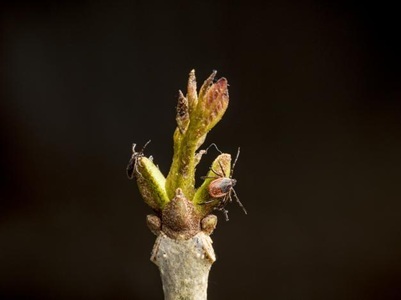
Ticks are responsible for approximately 90% of all vector-borne diseases in the United States. Credit: Robin Moore / Cary Institute of Ecosystem Studies
A 35-year ecological monitoring program has revealed that some of the longest-held assumptions about what drives Lyme disease risk are wrong—and identified the factors that actually matter.
Lyme disease, caused by the bacterium Borrelia burgdorferi and spread primarily through blacklegged tick bites, is diagnosed in nearly half a million people in the U.S. each year. Since 1991, researchers at the Cary Institute of Ecosystem Studies have tracked how acorns, rodents, ticks, predators and climate interact across a 2,000-acre forest in New York's Dutchess County.
“Studies of this depth and length are incredibly rare,” said Shannon LaDeau, a disease ecologist at the Cary Institute who co-directs the program with Richard Ostfeld. “This research has followed an ecological community—including oak trees, mammals, and microorganisms—examining how interactions like predation, parasitism, and competition shape the system over time. The evolution of understanding summarized in this paper is something you simply cannot get without such a long-term and system-focused study.”
Deer matter less, mice matter more
For decades, researchers assumed white-tailed deer played a major role in spreading Lyme disease since hunted deer often carry large numbers of adult ticks. But the new study, published in Proceedings of the National Academy of Sciences, found no statistical relationship between deer abundance and the density of nymphal ticks.
White-footed mice are the more important drivers. A strong mouse year boosted the following year's nymph population by about 40%, since mice are both a preferred host for tick larvae and highly efficient at transmitting B. burgdorferi.
The researchers also documented a delayed chain reaction: acorn masting, when oak trees drop unusually large numbers of acorns at once, fuels a mouse population boom the following year, which drives up nymphal tick numbers the year after that.
An infection puzzle
Since mice are so good at transmitting Lyme bacteria, the team expected more mice would also mean a higher percentage of infected tick —and that held true in the study's early years. But the relationship tapered out.
The data eventually pointed to an explanation: in years when other hosts, such as skunks, squirrels and opossums, were also abundant, they diluted the effect, since those animals rarely pass on the bacteria.
“The infection prevalence in the nymphs really depends on how all the larval tick meals are distributed across all the hosts,” Ostfeld said.
Ticks survive extremes
Previous lab studies suggested extreme heat and cold kill ticks outright. But in the field, ticks appear to survive temperature extremes by sheltering deeper into soil and leaf litter. The team did find one climate-linked trend: warmer years overall predict lower nymph numbers, even though warmer conditions tend to boost mouse populations—a mix of effects the team plans to continue monitoring.
The findings suggest that, despite the complexity of the system, Lyme disease risk is ultimately predictable, which could help public health officials anticipate high-risk periods and target prevention efforts more effectively.
The team plans to keep tracking how ticks, their hosts and oak trees respond to climate change, landscape change and invasive species.
“We need to know what to expect from the different manifestations of climate change, which are sometimes warmer and drier, and sometimes warmer and wetter,” Ostfeld said. “The time of year when it's very warm also matters to ticks, oaks and acorn production.”