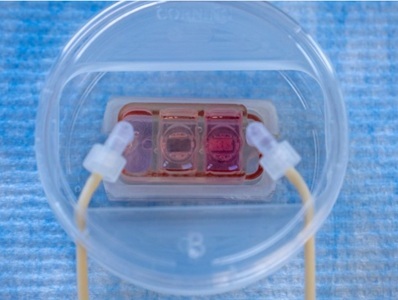
Columbia team modeled how cancer spreads to other organs using lab-grown bone and lung tissues. Credit: Steve Zill/Columbia Engineering
Columbia University engineers have built the first lab-grown, multi-organ chip that mimics how cancer cells travel through the bloodstream and colonize distant organs, offering a human-tissue alternative to animal models for studying metastasis.
Metastasis accounts for at least two-thirds of cancer deaths, but drugs targeting that spread have largely failed, partly because differences between human and rodent biology limit what animal models can reveal about organ colonization.
For this study, published in Science Translational Medicine, researchers built a chip containing compartments with millimeter-sized engineered human bone and lung tissues, and the vascular flow that contains circulating breast cancer cells and allows the dynamic cross-talk of the tissues being colonized.
The bone, lung and vascular endothelium in the chip were engineered from induced pluripotent stem cells using tissue-specific culture systems, then linked through a selectively permeable endothelial barrier that separates the tissue compartments from the vascular channel, much as it does in the human body.
When the researchers introduced breast cancer cells into that circulation, cells that typically gravitate toward bone showed stronger bone colonization and more pronounced bone degeneration, while cells that typically gravitate toward the lung caused greater disruption there and only modest bone colonization—patterns consistent with how metastasis unfolds in patients.
Follow-up analysis also showed signs that cancer cells “condition” distant tissues to be more receptive to colonization even before arriving, a process known as pre-metastatic niche formation.
“Cancer is very smart, unfortunately. We learned how the cells cross barriers to get from blood circulation into the tissues,” said Vunjak-Novakovic, study author and engineering professor at Columbia. “We were also able to reproduce something that happens in patients, where cancer cells condition the target tissues, even before they colonize them, to make them more receptive.”
The chip reflects a broader shift toward engineered human tissue models, as regulators place growing emphasis on alternatives to animal testing. In the future, the chip's ability to use patient-specific cells could help researchers uncover molecular pathways and therapeutic targets that have been difficult to study directly in humans.
Data from Columbia University