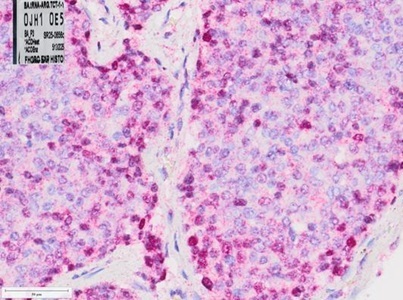
Microscope image of human prostate cancer with a high amount of a distinct tRNA, as shown in dark purple/pink staining. Credit: Hsieh Lab, Fred Hutch Cancer Center
Researchers at Fred Hutch Cancer Center have identified a previously overlooked molecular regulator that helps determine whether prostate tumors remain sensitive to treatment or evolve into a more aggressive, drug-resistant form of the disease.
Prostate cancer can shift cellular characteristics over time. Initially, prostate cancer depends on the activity of the androgen receptor, a protein that fuels tumor growth and is the primary target of standard therapies. But, many tumors shift to an androgen receptor-independent state. Once independent of the androgen receptor, prostate cancer tumors become more aggressive and less responsive to therapy.
First author Yeon Soo Kim, a Fred Hutch postdoctoral researcher, used prostate cancer cell lines, mouse models and tumor samples from patients to examine the role of tRNA in the transition from normal to aggressive.
According to the study results, across all model systems, Kim and her team observed a consistent pattern: a specific tRNA called tRNA1Arg(UCU) was high in androgen receptor-dependent prostate cancer cells but diminished in less androgen receptor-dependent, treatment-resistant tumors. Further experiments revealed that treatment-resistant tumors, when given the specific tRNA, could go back to being sensitive to treatments targeting the androgen receptor.
“We found that we can shift the cell state between androgen receptor-dependent to an androgen receptor-independent state with a single tRNA,” Kim said. “This is important because changes in cell identity are a major reason prostate cancers become resistant to treatment. We found that this tRNA can influence whether cells remain in a drug-sensitive state or transition to one that is more aggressive.”
Kim says the findings could be applied to other diseases, as well, including lung and breast cancers and any other types that undergo identity switches after treatment.
The team is now looking into how tRNA could be used as a biomarker or therapeutic target for aggressive prostate cancer, which could help guide more precise treatments or new treatments for patients.
Data from Fred Hutchinson Cancer Center