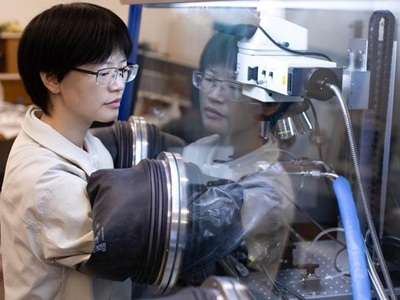
Mengke Liu, assistant professor of physics at The University of Texas at Dallas, operates a two-dimensional transfer stage inside a glove box to fabricate atomically thin quantum devices. Credit: University of Texas at Dallas
Researchers have discovered an unusual atomic pattern in a uranium-based material that gives it a rare combination of magnetic properties, a finding that could open new pathways for designing advanced electronic and computer memory devices.
Mengke Liu, an assistant professor of physics, was examining a uranium oxytelluride (UOTe) compound another professor had synthesized. Using transmission electron microscopy and scanning tunneling microscopy, Liu detected the presence of a repeating, twisted structural pattern of atoms, called a chiral superlattice, in the UOTe sample. Electrons moving through this structure behaved in unexpected ways, which the researchers determined was the result of the material having both ferromagnetic and antiferromagnetic characteristics.
Ferromagnetic materials are magnetic, while antiferromagnets have a net magnetization of zero.
“Finding a single material that combines both of these properties is interesting fundamentally,” Liu said.
Further examination and collaboration confirmed that the material’s unique atomic organization is a key factor governing how electrons travel through it. The combined properties of the material could be valuable for future magnetic computer memory technologies. Antiferromagnetic materials are generally more resistant to perturbations from external magnetic fields and can operate more quickly than conventional ferromagnets.
“If those advantages can be harnessed, memory devices could potentially become both faster and more robust,” Liu said.
The researchers also conducted computational analyses that suggest that hundreds of related compounds could host similar superlattice structures.
Liu said the discovery highlights the importance of reexamining known materials with modern experimental tools.
“Uranium oxytelluride has been known since the 1960s, but it has been largely ignored in research since then. Now, with today’s techniques, we’re able to uncover and study properties that previously were hidden,” she said.
Data from University of Texas at Dallas