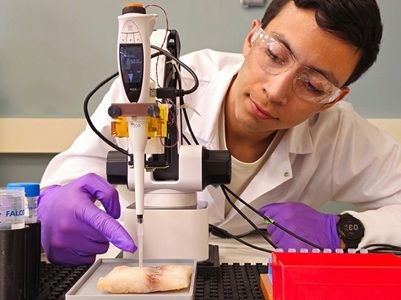
Jesus Ladino, a visiting scholar with the Undergraduate Research Experience Purdue-Colombia program through the Colombia Purdue Partnership, develops software for an automated surface touch extraction prototype at Purdue University’s Bindley Bioscience Center. Using the robotic system, researchers are testing different probes to evaluate their ability to recover lipids and proteins from samples like the grocery store tilapia fillet pictured. Credit: Purdue University/Karen Chibana
A patent-pending technique developed at Purdue University eliminates sample preparation in LC-MS/MS—one of the biggest bottlenecks in lab science and a major pain point for researchers everywhere.
The method, called surface touch extraction imaging (STEi), allows researchers to analyze irregular surfaces such as tissue biopsies, food items or packaging for metabolites, lipids, environmental compounds and proteins without cutting, grinding or otherwise destroying the sample.
“[Traditional sample preparation] destroys the sample and throws away spatial information about where a chemical was found in the sample,” said study author Christina Ferreira, research assistant professor at Purdue's Bindley Bioscience Center. “If scientists want to spatially analyze an irregular surface such as a piece of liver tissue or a fish fillet, they must section it and make it flat to be able to extract the chemicals before the analysis.”
With STEi, a user places an intact, unprocessed sample on the instrument stage, where an integrated imaging module scans its surface and software maps out where an extraction probe should touch and in what order. A pressure-controlled probe tip then briefly contacts each point, allowing proteins and lipids to diffuse into a solvent within seconds—regardless of how uneven the surface is. The software then registers the resulting molecular data back to the sample's original coordinates, producing a spatial heat map showing where specific lipids, contaminants, proteins or metabolites are concentrated.
The new approach improves on traditional workflows in several ways. Sampling typically takes just five to 15 seconds per point, and because the process only touches the surface, the same sample can be tested repeatedly over time. The collected extracts are compatible with multiple instruments, including autosamplers paired with LC-MS/MS. And because STEi is automated and pressure-controlled, it doesn't require specialized sample-prep expertise to run.
“For a food safety scientist, this means going from a half-day destructive assay to a few minutes of automated scanning,” Ferreira said. “For a toxicologist, it means understanding drug distribution across an organ rather than just knowing the average concentration.”
The team's first target application is food safety, but the researchers also see potential in drug development and toxicology, where STEi coupled with mass spectrometry could map how drugs, chemicals and proteins accumulate across liver, kidney, brain and intestinal tissue in animal models.
Using a manual version of the technique, the team has already recovered lipids and about 2,000 different proteins from bovine muscle, spanning contractile, metabolic, antioxidant and structural categories.
Next, the team is seeking industry partners to help optimize the hardware, integrate software for 3D path planning and run additional validation experiments in food spoilage monitoring, packaging contamination detection and toxicology.