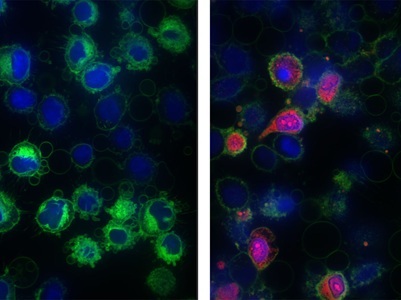
Sugar delivery to cells. Credit: University of Manchester
Researchers at the University of Manchester have developed a simple, solvent-free way to transport water-soluble sugars directly into mammalian cells, opening new possibilities for studying disease and developing therapies.
For the study, published in Angewandte Chemie International Edition, Matthew Gibson and his team used a small superchaotropic nanostructure made of boron to carry glycans across the cell membrane, eliminating the need for cytotoxic organic solvents such as dimethyl sulfoxide (DMSO).
Glycans play a crucial role in biology, from cell signaling and recognition to interactions with pathogens. Changes in glycosylation are linked to disease states, including cancer. But because many glycans are highly water-soluble, they can't easily cross the cell membrane on their own and must be chemically modified with a water-repelling group, then delivered using solvents that can damage cells.
One widely used technique for studying glycans, called metabolic oligosaccharide engineering, introduces modified sugars carrying a chemical "handle" into cells so researchers can track and study their biological functions. That method runs into the same membrane-crossing problem.
To get around it, Gibson's team developed a new boron-based delivery approach to introduce the unnatural sugars into the cell where they were metabolized and used to “edit” the surface of the cell. The “handle” from the modified glycan, now on the cell surface, can then be used to potentially reprogram or add new cell functions.
The researchers also used the technique to investigate glycoRNA—RNA molecules linked to glycans that were only recently discovered.
"Glycans are crucial molecules for the study of health and disease, but also biorefining and biomanufacture," said Gibson, chair in sustainable biomaterials at Manchester. "We typically accept that we need to chemically alter sugars to get them inside the cells to do their function. This work shows a fairly straightforward method to deliver sugars directly into the cells, and of real importance for us, it eliminates the need for organic solvents."
By removing some of the barriers to intracellular glycan delivery, the researchers believe the approach could open new opportunities across glycobiology and cell-surface engineering, as well as related fields including autophagy, cryobiology and infection research.
Next, the team plans to focus on increasing how much glycan can be transported into cells, with the goal of matching the delivery efficiency of existing solvent-based methods.
Data from University of Manchester