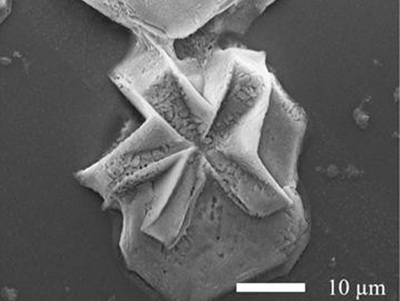
Eco-friendly perovskite material that transforms into a flower-like shape when exposed to ammonia. Credit: Korea Institute of Materials Science (KIMS)
Researchers in South Korea have developed an ultrasensitive, environmentally friendly ammonia gas sensor that can detect leaks at concentrations as low as 1 part per million, offering a safer alternative to lead-based sensing materials used in industrial gas detection today.
Conventional perovskite gas sensors detect ammonia effectively but typically contain lead, which limits their potential for wider commercial use.
For the study, published in Small Structures, researchers at the National Research Council of Science and Technology built a sensor using a lead-free perovskite material based on antimony, known as formamidinium antimony bromide.
The new sensor's electrical signal rose consistently as ammonia concentrations increased, allowing it to measure levels quantitatively rather than simply flagging a leak. When exposed to ammonia at 100 parts per million, the sensor responded within 13 seconds, with its electrical signal increasing by as much as 235 percent. It also showed much weaker responses to other gases, including methane, carbon monoxide, nitrogen oxides, hydrogen and methanol, confirming strong selectivity for ammonia specifically
After two months is storage, the device retained 97 percent of its original performance.
The researchers also identified a new ammonia-sensing mechanism—one not previously described. Rather than ammonia molecules simply adsorbing onto the surface of the sensing material, as conventional explanations suggest, the researchers found that ammonia molecules reversibly intercalate into the perovskite material itself, inducing a doping effect that increases its electrical conductivity and generates the sensor's signal.
Because the sensor can be fabricated through a simple spin-coating process, the researchers say it's well suited for large-area, lower-cost manufacturing, and could eventually be developed into portable detectors, pipeline-mounted sensors or real-time hazardous-gas monitoring systems for ammonia production, storage and transportation facilities.
Data from National Research Council of Science and Technology