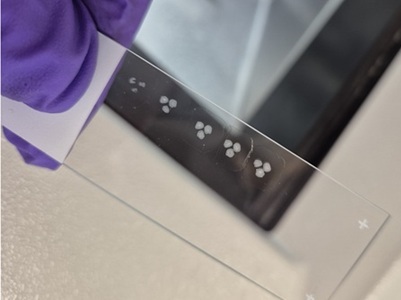
Lab-grown brain organoids on a glass slide. Credit: D.C.N. van der Heijden/UMC Utrecht
An international team of researchers has kept brain organoids alive and developing for more than five years—far longer than has previously been achieved.
The human brain continues developing until around age 20 but studying that process has traditionally relied on donated brain tissue or animal models—both limited, since donated tissue only offers snapshots of development, and animal brains differ from human brains in cell composition and developmental timing. Brain organoids offer a way around those constraints, but until now, most studies had only been able to capture the earliest stages of brain development because organoids couldn't be sustained in culture long enough to observe more.
In new research, scientists at UMC Utrecht set out to determine just how long human brain organoids could continue to mature.
The main hurdle was keeping the organoids' neurons active over an extended period, since standard culture conditions weren't built to support neuronal activity for years at a time.
“During human brain development, neurons display spontaneous activity,” said study author Noelia Antón-Bolaños, associate professor at UMC Utrecht. “By adapting the composition of the culture medium, we supported that activity, kept the neurons active and maintained the neuronal populations for much longer.”
In the study, published in Nature, the team found several signs that the organoids weren't simply surviving, but continuing to develop much as a human brain does. Different brain cell types emerged in the same order seen in human development, neurons formed increasingly complex connections over time, and genes switched on and off close to when they would in vivo.
Some of the clearest evidence came from small chemical modifications to DNA that accumulate in a characteristic pattern as the human brain matures—a pattern the organoids also followed.
After about a year in culture, the organoids even displayed features that typically don't emerge until after birth.
“The cells are outside the body, yet they still follow approximately the same developmental timeline as we do—and even more closely than we had anticipated,” said Antón-Bolaños.
The researchers also found that older cells retained a memory of their developmental stage. When cells from an older organoid were dissociated and allowed to regrow on their own, they produced cell types typical of a late developmental stage. But when those same older cells were combined with younger cells, they regained the ability to produce neurons, though only the types associated with later developmental stages. That finding is notable because the human brain normally stops producing neurons relatively early before switching to producing glial cells.
“If we can identify the signals that reactivate neuron production in older cells, it could provide new ways to study neurodegenerative disorders,” said Antón-Bolaños.
Because the organoids continue maturing for years rather than weeks, researchers can now study a much larger stretch of human brain development in the lab—a capability the team believes could be especially useful for studying conditions like autism spectrum disorder and schizophrenia, in which atypical neurodevelopment plays a central role.
The brain organoids are highly reproducible. This is essential for using them as disease models, and may eventually support drug-testing studies in organoids.
The organoids are still developing in the laboratory. The researchers now want to determine how environmental cues, such as stimulation with light, improve further maturation. The field also aims to improve features that remain incomplete, including vascularization and the layered organization of the cerebral cortex.
“We now know that these models have the capacity to continue developing for years,” said Antón-Bolaños. “The next step is to understand how to provide optimal conditions for that capacity to unfold. That will bring us closer to more faithful models of the human brain.”