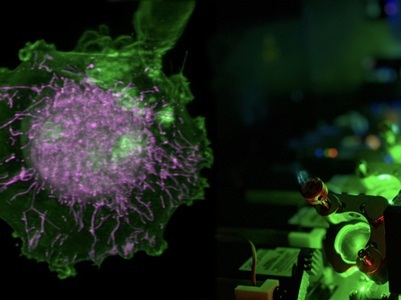
An AI model called MitoSpace and "digital twins" of real cells could help scientists find new treatments for diseases such as cancer, diabetes and Alzheimer’s. Credit: UC San Diego Health Sciences
Researchers at the University of California San Diego have built two types of "virtual cells" that use 4D movies of living mitochondria to predict how real cells will respond to drugs. This approach could reduce reliance on time-consuming lab experiments and speed up the search for new treatments.
For the studies, published in Cell, researchers used 4D lattice light-sheet microscopy to build two complementary models. The first model, a deep-learning AI system called MitoSpace, was trained on 40,000 single-cell 4D movies of cancer cells treated with 25 different compounds known to disrupt mitochondria. Rather than requiring researchers to manually label the images, MitoSpace found patterns on its own, ultimately grouping cells that responded to drugs in similar ways and predicting a cell's energetic state based purely on the shape and movement of its mitochondria.
When trained on the 4D movies, the model distinguished between drugs and sorted them by mechanism with 75 percent accuracy, compared with 56 percent accuracy using the flat 2D images common in large-scale drug screens today.
In the other Cell study, researchers created a physics-based “digital twin” of a real cancer cell. Using specialized image-analysis software, they mapped the positions of mitochondria and of the microtubule tracks they travel on, then added the motor proteins that transport them according to previously established rates.
When researchers tested the digital twin against a drug called nocodazole, which partially breaks down microtubules, the virtual cell reproduced the reduced motion and altered fusion and fission rates seen in real treated cells, without adjusting a single parameter.
"A cell is a four-dimensional object: it has depth and it never stops moving," said corresponding author Johannes Schöneberg, associate professor at UC San Diego School of Medicine. "Virtual cells need to be built on data that captures that fact."
Next, Schöneberg's team plans to combine the two approaches into a single workflow, using MitoSpace to find patterns in large datasets and digital twins to explain the physical reasons behind them. The researchers ultimately hope to build a complete virtual human cell, and eventually model whole tissues made of multiple interacting cells to simulate more realistic human biology and inform clinical treatment.
Data from UCSD