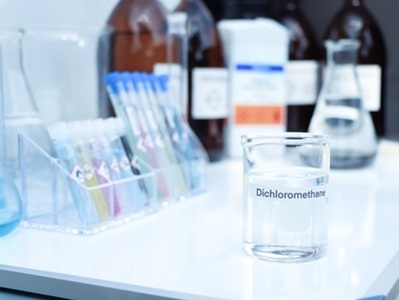
A widely used industrial solvent that chemists have relied on for decades may have a second job: helping build the amide bonds that hold together everything from proteins to pharmaceuticals.
Amide bonds are essential chemical linkages found throughout biology and medicine—the peptide bonds that connect amino acids into proteins are a class of amide bond, and the linkage is also central to many drugs and polymers. Building these bonds efficiently has long been a priority in green chemistry, but most standard methods rely on coupling reagents that activate carboxylic acids before they can react with amines.
For the study, published in the Journal of the American Chemical Society, a team led by Sunwoo Lee, professor of chemistry at Chonnam National University in South Korea, found that dichloromethane—an inexpensive, widely available solvent already common in chemical labs—can itself act as an effective coupling reagent for direct amide synthesis.
“Dichloromethane is a commonly used solvent in many chemical processes,” Lee said. “In this study, we present the successful application of this common solvent to facilitate efficient and scalable amide bond formation.”
The reaction works because, under basic conditions, carboxylate ions attack dichloromethane in a substitution reaction, generating a reactive chloromethyl ester intermediate. That intermediate then reacts with amines to form the desired amide. Using benzoic acid and benzylamine as test compounds, the researchers found that sodium carbonate as a base, dichloromethane as the coupling reagent and dimethyl sulfoxide as the solvent produced amides in good yield, with the best results achieved at 80 degrees Celsius over a 12-hour reaction time using excess amine.
The method also worked across a broad range of carboxylic acids and amines, including two pharmaceutical compounds: the antiarrhythmic drug procainamide, synthesized at 92% yield, and the antidepressant moclobemide, at 76% yield.
The researchers also showed the reaction could proceed directly from carboxylic acids and ammonium bicarbonate in a single step. To test whether the approach could scale beyond the lab bench, the team ran a 100-millimole reaction using 4-chlorobenzoic acid and 2-morpholinoethanamine, producing more than 20 grams of moclobemide at greater than 99% purity.
Follow-up mechanistic studies confirmed that the main reaction pathway involves the carboxylate attacking dichloromethane to form an activated ester, though a secondary pathway can also generate a methylene bis(carboxylate) intermediate capable of undergoing its own reaction with amines.
“By avoiding many conventional stoichiometric coupling reagents and reducing coupling-reagent-derived waste, our approach demonstrates that dichloromethane can provide a practical and scalable alternative for amide synthesis,” Lee said.