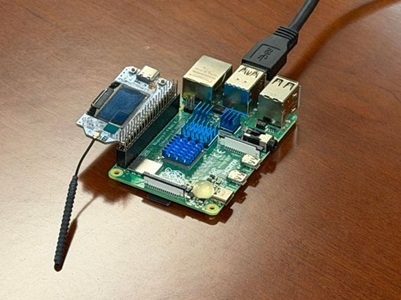
A sensor used for CoughNet by Ismail's team, featuring a Raspberry Pi single-board computer. Credit: Dali Ismail
A team of Binghamton University researchers has developed a sensor system aimed at helping medical professionals more efficiently monitor how many people are coughing—and potentially spreading disease—within a given area.
The prototype, dubbed “CoughNet,” is a series of “listening stations” that detect coughs, determine if the sound was indeed a cough, and then check whether the cough came from a person who was already recorded or from a new individual.
To accomplish this, researchers placed three Raspberry Pis—small, inexpensive single-board computers with built-in microphones—around a room. When someone coughs in the room, all three hear the sound, but the one closest to the person who coughs hears it the loudest.
The computer then captures a short recording of the cough and runs the sound file through an AI model that determines whether the sound is an authentic cough. The system also analyzes the recording from all three microphones, examining how strong the cough was and how long the sound took to reach it in order to determine who coughed. It does not determine that “Person X” coughed, only that a cough occurred and whether it’s the same person multiple times.
“The microphone closer to the source acts as a reference microphone, and we can do correlation to determine if this cough is from the same exact person, because the same cough will be heard by the two other microphones, which are a little bit far away,” Ismail said.
The system is not only effective but efficient. Raspberry Pi computers cost less than $50 and are extremely energy-efficient. The devices use low-power, long-range (LoRa) wireless technology, which covers far more indoor space than a single Wi-Fi access point while using so little power that sensors can run for years on batteries.
In its current state, CoughNet listens to audio and deems that it is a cough. A large goal going forward is to analyze coughs for more context by examining their specific acoustic signatures and checking if the sound characterizes the cough of a specific disease, such as a flu-like illness, COVID or bronchitis.
Data from Binghampton University