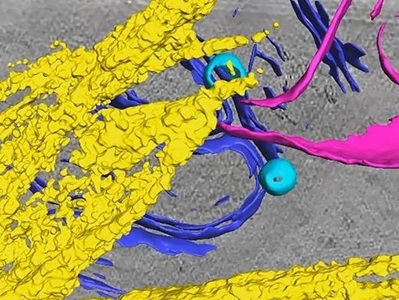
Fibrils (yellow) inside a sperm cell. Credit: William Mallen/Fitzpatrick lab/Columbia's Zuckerman Institute
Amyloids, protein fibers best known as a hallmark of Alzheimer’s disease, may play a vital role in semen, helping shepherd genetic material into sperm cells, scientists at Columbia's Zuckerman Institute report in a new study published in Molecular Cell.
The study examined how RNA in seminal fluid, thought to shape which genes are active in developing embryos, gets into sperm. Semen holds plenty of small RNAs, but how they cross from seminal fluid into sperm cells has been a mystery.
The work began with HIV. Amyloid fibrils in semen were known to help the virus, which stores its genetic material as RNA, enter cells in the reproductive tract, suggesting the fibrils might help RNA in general. The match made chemical sense: amyloids are positively charged and RNA is negatively charged, so the two attract. Fluorescent labels on both confirmed they bind, and because amyloids are exceptionally durable while RNA is fragile, the fibrils may also shield their cargo from harsh conditions.
Cryo-electron tomography showed gold-labeled amyloids actually inside sperm cells, rather than just stuck to their surfaces. A fluorescent protein revealed that amyloids greatly sped up how quickly RNA entered sperm. Once inside, a protein called clusterin helped separate the RNA from the amyloid. The fibrils carried not only small RNAs but RNA large enough to encode green fluorescent protein, and embryos fertilized with that sperm made at least 10 times more of the protein than embryos from sperm exposed to the RNA without amyloids.
What the delivered RNA does once inside sperm remains unknown. Earlier research found that RNA in semen can switch genes on or off in offspring, and that these epigenetic changes, which can be shaped by a parent’s experiences, can be inherited across generations. Metabolic disorders such as insulin resistance, for example, have been shown to pass down the paternal line in mice, with RNA thought to be the carrier. Understanding how such epigenetic disorders work could bring scientists closer to treating or preventing them.
The fibrils could also become delivery tools. CRISPR, which relies on RNA, has set off a revolution in genetics, and hundreds of clinical trials are testing it for gene therapies. Delivery often depends on modified viruses, which can trigger immune reactions. Amyloids might one day shuttle therapeutic genes into cells and embryos instead.
“Since the amyloid fibrils we looked at are human-based, hopefully the immune system won’t react in the same way they do to the repurposed viruses often used in gene therapy,” said William Mallen, lead author of the study and a medical student at the University of Vermont.
Data from The Zuckerberg Institute at Columbia University