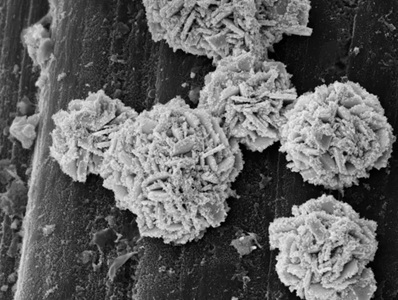
The spherical structures resemble desert roses and consist of tiny gold platelets "dusted" with platinum particles. Credit: Debasis Maity, Biotechnology and Bioengineering Group / ETH Zurich
Researchers at ETH Zurich have developed an implantable system that uses an electrically powered catalyst to lower blood glucose. In tests, the device led to weight loss in diabetic mice.
For years, researchers have explored systems that regulate blood sugar, relying on specially developed genetic networks. Those approaches depend on biological components, which pose challenges in immune tolerance, stability, manufacturing and regulatory approval.
The new system avoids that problem with a catalyst made entirely of inorganic materials, needing no cells, enzymes or other biological components. It consists of graphite felt studded with gold nanoclusters, which are decorated with even smaller platinum particles.
The ETH team developed the catalyst’s nanostructured surface themselves, with the materials showing excellent biocompatibility in the experimental study. The implant also contains an electronic control unit in a 3D-printed casing, powered wirelessly at 13.56 MHz, a frequency internationally designated for industrial, scientific and medical applications.
According to the study, the catalyst converts excess glucose in the blood into gluconate, so that some of the glucose is no longer metabolized and stored in tissue, which also helps limit the build-up of body fat. The gluconate is then excreted in urine.
The catalyst is controlled wirelessly through a closed-loop system. A standard glucose sensor, like those commonly worn on the upper arm by people with diabetes, continuously monitors glucose levels in the tissue. If blood sugar climbs too high after a meal, the sensor signals a smartphone or smartwatch via Bluetooth, which activates the catalyst. Once glucose falls to the desired level, the device switches itself off automatically, protecting patients from dangerously low blood sugar.
In a laboratory experiment, the team tested the catalyst in a reservoir holding 5 liters of glucose-containing nutrient solution—roughly the volume of blood in the human body—and showed it could convert glucose in that volume.
In diabetic mice, the animals’ blood sugar could be precisely regulated, the mice lost weight, and the implant was well tolerated and operated reliably over six weeks.
“The system operates at a very low voltage, and our experiments showed no evidence of tissue damage from either electrical or thermal effects,” said lead researcher Martin Fussenegger.
He sees the approach as a paradigm shift away from conventional drugs and toward scalable, electronically controlled treatments that can be integrated into digital environments, such as the Internet of Things.
“For decades, we have treated diabetes by telling the body how to manage glucose. We are now showing that we can take control of glucose directly, using electronics rather than drugs,” Fussenegger said. “And the catalyst only activates when glucose levels are too high.”
The team now plans to develop the system into a medical device. Because the glucose-lowering mechanism works without cells or enzymes, technical development could be more straightforward, and the components needed to build such a device—including external control and wireless power transmission units—are already commercially available.