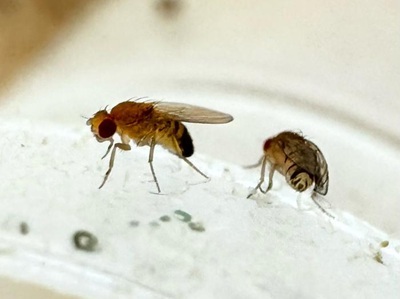
What makes one brain different from another? Research in fruit flies (Drosophila melanogaster) suggests that “jumping genes” could be an overlooked source of individual differences in the brain. © Christoph Treiber
Researchers have found that so-called "jumping genes" are surprisingly often incorporated into the genetic messages made by cells in the fruit fly brain.
Scientists already knew that these mobile stretches of DNA, known as transposable elements (TEs), play an important role in shaping animal genomes, sometimes becoming part of the RNA messages produced from genes. But the new study reveals that this happens particularly frequently in the brain, potentially giving brain cells another way to generate a greater variety of proteins.
In the new study, published in eLife, researchers at the University of Oxford used an improved computational analysis pipeline called TEChim to measure how often TE sequences were included in messenger RNA in the fruit fly brain.
The method allowed the researchers to identify where jumping gene sequences were incorporated into RNA messages, as well as measure how often the altered message was produced compared with the usual version.
According to the study results, across the 264 TE-gene pairs tested, an average of 17.8% of messenger RNA molecules contained TE-derived sequence, with some genes incorporating these sequences into nearly all of their transcripts.
What makes this mechanism particularly interesting is that, unlike most genes, TEs vary considerably between individuals. This raises the possibility that two flies carrying different TE insertions may produce different versions of the same neural genes.
Although the work was carried out in fruit flies, similar TE-containing RNA messages have been identified in mammals, including humans. This raises the possibility that the incorporation of TE sequences into RNA could be a widespread way in which genomes expand the diversity of the proteins they can produce.
The research team said they will now focus on how these RNA variants produce new versions of proteins and how they affect brain function, whether different types of brain cells use different TE-derived sections, and whether variations in TEs contribute to differences between individuals.
Data from University of Oxford