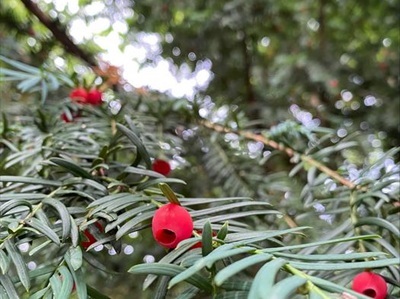
This is the yew tree, that originally produces the cancer drug taxol (paclitaxel). Credit: Feiyan Liang, University of Copenhagen
The widely used cancer drug taxol (paclitaxel) is one of the most expensive medicines available. Used to treat breast cancer, ovarian cancer and lung cancer, taxol comes from the yew tree, where the active compound is produced in the bark. For modern medicinal purposes, researchers extract compounds from the bark and convert them into the drug through a series of chemical reactions.
Although taxol has long been produced for cancer treatment, there has never been a complete manual describing the process that the plants use to make it. Now, researchers have assembled that missing guide.
In the study, published in Nature Chemical Biology, researchers took candidate genes responsible for taxol production from the yew tree and introduced them into another plant—the tobacco species Nicotiana benthamiana. This plant grows quickly and is widely used in research.
The researchers succeeded in getting the tobacco plants to produce taxol at levels comparable with those found naturally in yew tree bark.
“The tobacco plant is an effective platform for growing taxol because it provides the same cellular environment as the yew tree but is a lot faster to grow and easier to engineer,” said senior author Sotirios Kampranis, professor in the Department of Plant and Environmental Sciences at the University of Copenhagen.
For tobacco plants to be used in large-scale production in the future, the yew tree genes will need to become a stable part of the plant’s own genetic makeup.
“That is the next major challenge,” said Kampranis.
In addition to using tobacco plants to produce the cancer drug, the researchers point to other possible production methods.
“Now that we have the crucial blueprint for biosynthetic taxol production, there is potential to produce it in many different ways. We also see fermented yeast cells as a promising solution,” said Kampranis.
Data from University of Copenhagen