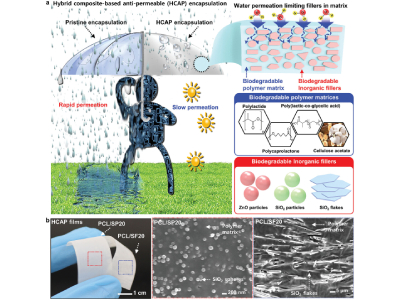
Flexible, biodegradable hybrid composite-based antipermeable (HCAP) encapsulation for transient electronics. Credit: Gwan-Jin Ko et al.
Researchers have developed a method to control the dissolve rate of the biodegradable electronics commonly employed as medical devices. Controlling the degradation rate of these devices could allow for the development of new or improved medical devices.
Biodegradable electronics enable medical devices, such as drug delivery systems, pacemakers or neural implants, to degrade and be absorbed by the human body after they are no longer needed. However, if these devices degrade too quickly, they cannot provide sufficient treatment.
In the research, published in Advanced Functional Materials, a team of researchers from Penn State have developed a method to control the dissolve rate of these devices. The team experimented with various inorganic fillers and polymers to encapsulate the device and control degradation.
"In this work, we developed an encapsulation strategy that allows a device to remain in the body without degrading for over 40 days while retaining its mechanical properties, which surpasses previously reported devices," said Ankan Dutta doctoral student in engineering science and mechanics at Penn State.
By encapsulating the device in zinc oxide or silicon dioxide-based fillers, the usable lifespan of the medical device can be expanded to surpass 40 days within the body. Utilizing advanced modeling techniques, the team determined that coating the device in silicon dioxide flakes was the most effective means to control degradation. Additionally, the researchers optimized the with and thickness of the encapsulation after discovering it played a vital role in degradation rates.
"Inexpensively, we can fine tune how fast a device will degrade based on the aspect ratio, the types of materials used and how many fillers were used," Dutta said. "We are achieving what we call 'on demand transient electronics,' where we passively control how fast an implant degrades inside a body based on its materials."
The encapsulated devices provide a cost-effective non-intrusive means to passive degradation. "Devices that passively degrade on their own without the use of third-party systems are both inexpensive and more feasible to potentially use in a patient care setting in the future," Dutta added.