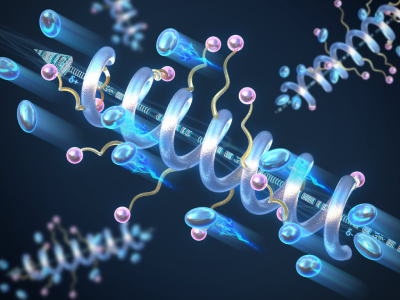
Credit: Artistic representation of a helical peptide polymer electrolyte with the macrodipole indicated by an arrow with positive and negative charges. Credit: The Grainger College of Engineering at the University of Illinois Urbana-Champaign
University of Illinois Urbana-Champaign researchers have described a potential novel structure to improve the performance of solid-state electrolytes.
Solid-state electrolytes have captured interest for decades due in part to their improved safety over their liquid electrolyte counterparts. Despite this, solid-state electrolytes will require novel ideas and concepts to push their performance to be a viable option for next-generation energy storage devices.
In their research, published in Nature Materials, the University of Illinois Urbana-Champaign researchers explored helical secondary structures' role on solid-state polymer electrolyte conductivity, ultimately discovering that helical structures greatly increase conductivity when compared to random coil structures.
"We introduced the concept of using a secondary structure—the helix—to design and improve upon the basic material property of ionic conductivity in solid materials," said Chris Evans, who led the research. "It's the same helix that you would find in peptides in biology, we're just using it for non-biological reasons."
While polymers tend to adopt random configurations, they can be controlled to form a helical structure providing them with a macrodipole moment. This macrodipole formation not only increases the conductivity and dielectric constant of the polymer electrolyte, it also improves the charge transport.
"These polymers are much more stable than typical polymers—the helix is a very robust structure. You can go to high temperatures or voltages compared to random coil polymers, and it doesn't degrade or lose the helix. We don't see any evidence that the polymer breaks down before we want it to," added Evans.
Additionally, because the material is made of peptides at the end of the battery's useful life the material can be dissolved and recovered thus reducing the environmental impact of the electrolyte.