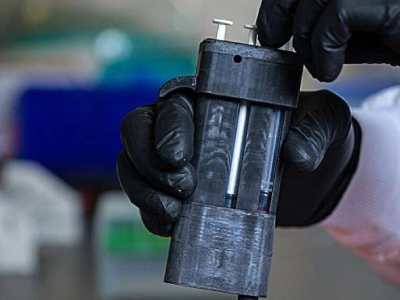
The acoustic pipette uses sound waves to test for biomarkers in blood. Credit: Patrick Campbell/CU Boulder
CU Boulder researchers have developed a novel sound-based diagnostic system capable of delivering blood biomarker results in under an hour. While the study was just a proof of concept, the researchers have worked with Venture Partners to explore methods for expanding the technology.
"We've developed a technology that is very user-friendly, can be deployed in various settings, and provides valuable diagnostic information in a short time frame," said Wyatt Shields, assistant professor in the Department of Chemical and Biological Engineering at CU Boulder.
While rapid tests have existed for some time in the form of lateral flow assays, they cannot quantify concentrations of a specific biomolecule. Additionally, while lateral flow assays can provide a rapid yes or no, they are often not sensitive enough to detect small amounts.
While the clinical blood test gold standard enzyme-linked immunosorbent assays, or ELISA, are highly sensitive and can quantify even rare biomarkers, results can take hours or days to arrive to patients.
To solve these challenges, the team developed a sensitive and portable device that was easy to use. Relying on tiny particles they dubbed functional negative acoustic contrast particles (fNACPs), and a custom-built handheld instrument called an "acoustic pipette" the team developed a system that uses soundwaves to measure blood biomarkers. Their work is published in Science Advances.
"We're basically using sound waves to manipulate particles to rapidly isolate them from a really small volume of fluid," said Cooper Thome, a Ph.D. candidate in Shields lab who specializes in the study of "acoustofluidics".
"It's a whole new way of measuring blood biomarkers," he added.
"In our paper, we demonstrate that this pipette and particle system can offer the same sensitivity and specificity as a gold-standard clinical test can but within an instrument which radically simplifies workflows," said Shields. "It gives us the potential to perform blood diagnostics right at the patient's bedside."
"We think this has a lot of potential to address some of the longstanding challenges that have come from having to take a blood sample from a patient, haul it off to a lab and wait to get results back," Shields added.