Researchers from the Lawrence Livermore National Laboratory (LLNL) have developed a new 3D printing technique which can build complex structures using two light wavelengths before cleanly dissolving the support structures. The method has the potential to expand current multi-material additive manufacturing capabilities.
Published in the journal ACS Central Science, the work describes a “one-pot” printing technique which uses two light wavelengths to create permanent structures and temporary supports within a single resin formulation. The method resolves the longstanding challenge of how to build suspended or overhanging features without the cumbersome support structures that require manual removal after printing.
"This work adds another option to the growing range of multi-material printing possibilities," said LLNL staff researcher Maxim Shusteff.
"Using multiple materials is critical to many manufacturing processes, and that's been hard to accomplish using 3D printing. And manually removing supports printed from the same material is one of the bottlenecks preventing the use of DLP in production activities and hurting part accuracy—dissolving a sacrificial material is much more automation-compatible and less cumbersome."
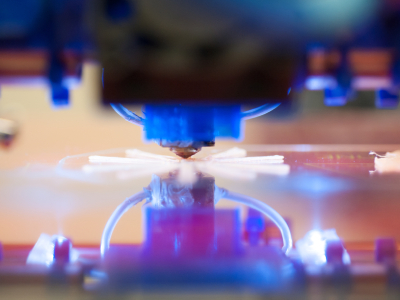
Key to the new technique is a custom dual-wavelength negative imaging (DWNI) DLP printer which projects both UV and visible light simultaneously, each triggering separate reactions. The UV light is used to solidify the final structure while the visible light cures the degradable support structures that are designed to dissolve after printing using a water-based solution.
The new technique offers a practical approach to minimize waste and reduce print time in a novel “one-pot” manner.
"Our one-pot embedded printing approach improves the fidelity of unsupported, free-floating structures, such as overhangs and cantilevers, by using degradable supports that act as temporary scaffolds to prevent collapse and misalignment during fabrication," said first author Isabel Arias Ponce.
"Additionally, mobile components—such as hinges and interlocking systems—could be fabricated in place by simply patterning a degradable interface between multiple parts. This would eliminate the need for manual assembly and enhance production efficiency."