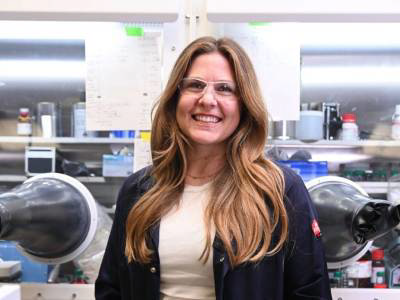
Megan Butala. Credit: Brookhaven National Laboratory
University of Florida engineers have developed a novel technique to investigate the atomic structure of thin films on single crystal substrates. Once optimized the technique could drive advancements in next-generation semiconductor devices by allowing atomic-level precision in their development.
The study, published in the journal Acta Crystallographica Section A Foundations and Advances, describes a machine learning based workflow which is capable of processing complex 2D x-ray total scattering data from the single crystal substrate thin film materials. Dubbed IsoDAT2D, the workflow isolates and identifies the unique fingerprints characteristic of the ultra-thin film materials found in technologies we use every day.
"If we understand what the atomic structure is, how to get that structure, and what properties that structure gives us, then we can design better materials from the start," added University of Florida engineering professor Megan Butala.
By improving how we detect the extremely subtle details in a thin film materials atomic structure, IsoDAT2D provides critical new insights into how these materials behave at the atomic level.
"This could accelerate the development of thin film materials in application environments for energy storage, semiconductors, and electronic materials, which could enable faster materials design and improve reproducibility and accessibility of X-ray scattering data," said Butala.
By resolving the atomic behaviors of thin films, the workflow developed by the team will allow targeted design and fabrication of novel materials that could revolutionize how we interact with technology.