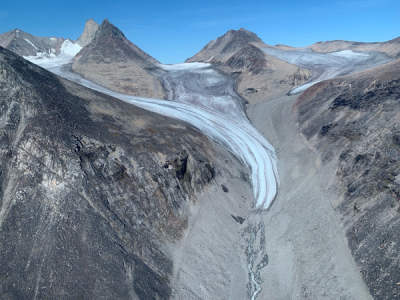
A glacier in the Canadian Arctic. Credit: John Gosse, Dalhousie University
New research published in the journal Nature Geoscience is providing the most comprehensive view of the speed at which glaciers erode, and how that erosion is changing landscapes. Perhaps even more importantly, the work provides estimates for erosion rates of more than 180,000 glaciers around the world.
Ushing a novel machine learning based analysis, the team has predicted the erosion rate for around 85% of modern glaciers, revealing that, on average, nearly all glaciers erode between 0.02 and 2.68 millimeters per year.
"The conditions that lead to erosion at the base of glaciers are more complicated than we previously understood," said University of Victoria (UVic) geographer Sophie Norris. "Our analysis found that many variables strongly influence erosion rates: temperature, amount of water under the glacier, what kind of rocks are in the area, and how much heat comes from inside Earth."
"Given the extreme difficulty in measuring glacial erosion in active glacial settings, this study provides us with estimates of this process for remote locations worldwide," added John Gosse, Dalhousie University.
The work provides critical insights into the complex factors which cause the erosion found beneath glaciers. The data is vital to better understand and monitor worldwide sediment and nutrient movements while providing improved landscape management and long-term nuclear waste storage.