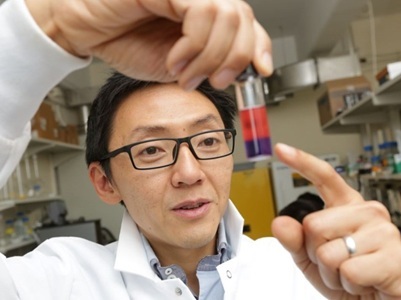
Credit: Columbia Engineering
Across the world, demand for lithium is skyrocketing as the need for batteries, like those that power electric vehicles, steadily increases. However, lithium is found in relatively few locations on the planet, and mining for the mineral is not environmentally friendly.
In a new paper, researchers from Columbia Engineering describe a new method for extracting lithium based on a temperature-sensitive solvent that could dramatically shorten processing time, unlock reserves that existing methods can’t tap, and reduce environmental impact.
The innovation, called switchable solvent selective extraction (S3E), can extract lithium with strong selectivity: up to 10 times higher than for sodium, and 12 times higher than for potassium. The process also excludes magnesium, a common contaminant in lithium brines, by triggering a chemical precipitation step that separates it out.
Unlike conventional lithium recovery methods, S3E doesn't rely on binding chemicals or extensive postprocessing. Instead, the process exploits the way lithium ions interact with water molecules in a solvent system that changes its behavior based on temperature. At room temperature, the solvent pulls lithium and water from the brine. When heated, it releases the lithium, along with water, into a purified stream and regenerates itself for reuse.
In lab tests using synthetic brines modeled on the Salton Sea, the system recovered nearly 40% of lithium over just four cycles with the same solvent batch. That suggests a viable path toward continuous operation.
While the study is proof-of-concept for now, S3E appears promising enough to offer an alternative to evaporation ponds and hard-rock mining.
“We talk about green energy all the time,” said Yip. “But we rarely talk about how dirty some of the supply chains are. If we want a truly sustainable transition, we need cleaner ways to get the materials it depends on. This is one step in that direction.”
Data from Columbia University School of Engineering and Applied Science