The SPECTROstar Nano is the next evolution in absorbance reader technology and BMG LABTECH is giving away five of these unique instruments for your ideas. Its proprietary ultra-fast UV-Vis spectrometer instantaneously captures a full spectrum in microplates, cuvettes and low volumes samples. It will redefine the most common absorbance assays such as ELISAs, DNA, RNA, protein (Bradford, BCA, Lowry), cell growth, and beta-galactosidase, while expanding your laboratory’s capability with different sample formats.
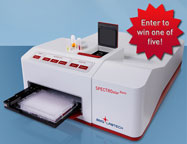
For your chance to receive one of five free SPECTROstar Nanos, just submit a short 2-4 page research proposal on how your laboratory would use the SPECTROstar Nano. Proposals will be evaluated based upon uniqueness of research. Tell us how you would use the instrument in a unique way and/or use one of its many unique features, such as: full UV/Vis spectrum per well, gas vent for atmospheric control, 1536 well plate reading capability, incubation and shaking, reference corrections to existing assays to improve data, cuvette and plate kinetic capability, BMG LATECH’s low volume LVis Plate, robotic interface mode or one of the other outstanding features that the SPECTROstar Nano offers. Winners will also be chosen by probability of success and thoroughness of the individual proposals. For more information go to www.bmglabtech.com/promotion or ask your local BMG LABTECH representative.
BMG LABTECH
Hanns-Martin-Schleyer-Str. 10
77656 Offenburg
Germany
www.bmglabtech.com