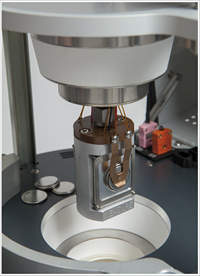
 August 1st, 2013 - NETZSCH Instrument North America, LLC (NETZSCH) announced a new high temperature coin cell module on MMC 274 Nexus®. Coin cells are directly used in many consumer products; and they are also a stepping stone in large battery development. Many parameters will influence the performance of rechargeable coin cell including temperature and cycling conditions. “It is important for the battery community to know the heat generation during charging/discharging cycles in order to understand the cell energy efficiency and improve cell performance, lifetime, and safety.”, commented Peter Ralbovsky, calorimetry expert at NETZSCH.
The new differential scanning calorimeter (DSC) is specially dedicated to coin cell battery studies and can easily be coupled with a fully featured battery analyzer. The user can perform in-situ charge/discharge tests in isothermal mode to measure battery performance and efficiency. In temperature scanning mode, the user can study cell safety and decomposition thermodynamics and kinetics up to 300 °C. This information will help battery researchers understand battery behavior for R&D and QA/QC.
“Our unique heat flux sensor is designed based on differential measuring principal. It results in improved stability and sensitivity to capture even weak heat signal from coin cell. A whole coin cell can be easily mounted onto the sensor.”, noted Jean-Francois Mauger, R&D director. “The sensor is also robust enough for even destructive test of coin cell battery which was not possible on DSC before.”
Please see the corresponding press release for further details.