Middleboro, MA - Brookfield welcomes three new instruments into its touch screen family of rheometers: the RST-CPS Cone Plate Rheometer, the RST-CC Coaxial Cylinder Rheometer and the RST-SST Soft Solids Tester Rheometer. The new RST Series offers the quickest and most comprehensive capability for making rheological measurements, whether it’s single point viscosity for QC or complete flow curve analysis for R&D.
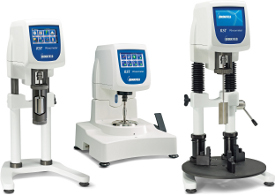
The RST Rheometers are unique because they operate in both controlled stress and controlled rate modes and can perform all of the following tests: viscoelastic modulus, yield stress, viscosity vs. shear rate profile, thixotropy calculation, creep behavior, recovery after flow, and temperature sensitivity. Every RST Rheometer offers the widest torque range available to handle the broadest range of sample materials (500 to 1 million dyne•cm). They provide exceptional versatility with the largest range of shear rates and DIN spindle geometries. The sturdy, rugged design of the RST is ideal for use in R&D, working in the QC lab, or on the production floor.
All RST models come with the standard option for 21 CFR compliance, including controlled user access and data integrity/security.
No other instrument offers so much capability at such a low price. For more information about Brookfield’s new family of RST Rheometers, visit www.brookfieldengineering.com/products/rheometers/laboratory.asp or call 800.628.8139 (USA and Canada) or 508.946.6200.