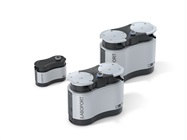
KNF has developed a new series of LABOPORT pumps: models N 96, N 820 G, and N 840. Their new diaphragm pumps are oil-free, non-contaminating, chemically resistant construction with a modern look and the added benefit of speed-controlled DC motors. The integrated knob controls evacuation speed and a color status display indicates whether the pump is in normal operation or on standby.
The N 820 G and N 840 G include a gas ballast valve to facilitate short process times. The smooth rounded surfaces of all three pumps enable easy and thorough cleaning. The new pumps are designed to optimize benchtop space and portability. The new models offer a 10 – 20% footprint reduction to free up valuable benchtop space and a 5 – 30% weight reduction for improved portability.
The modular approach of the two larger pumps enables easy expansion for custom-tailored vacuum systems by connecting an optional separator and/or condenser module. The maximum flow rates for the new models range from 7– 34 L/min with vacuum levels of 97.5 – 4.5 torr. The new generation of LABOPORT vacuum pumps will optimize a variety of applications including rotary evaporation, degassing, filtration, SPE, fluid aspiration, gel drying, centrifugal concentration, vacuum ovens, and more.
For more information, visit here.