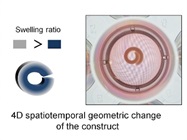
The next frontier for bioengineering is hydrogel-based material development. A University of Illinois at Chicago research team has developed an innovative hydrogel that alters shape based on environmental stimuli. Applications for their new hydrogel include vascular replacement therapy and other in vivo surgical tools. Their research is published in the journal, Advanced Functional Materials.
"Using a high density of cells can be advantageous in tissue engineering as this enables increased cell-cell interactions that can promote tissue development," stated Eben Alsberg, professor of orthopedics, pharmacology and industrial engineering at UIC.
Further research aims include the development of 4D materials, which are similar to 3D materials, but possess shape altering capabilities when applied to specific environmental stimuli (ie: water or light). Alsberg’s hydrogel is primed to make an excellent candidate to advance tissue engineering.
Yu Bin Lee, a biomedical engineering postdoctoral researcher and first author on the paper, said, "Using our bilayer hydrogels, we can not only control how much bending the material undergoes and its temporal progression, but because the hydrogels can support high cell densities, they more closely mimic how many tissues form or heal naturally". He continued, "This system holds promise for tissue engineering, but may also be used to study the biological processes involved in early development."
Image credit: Yu Bin Lee