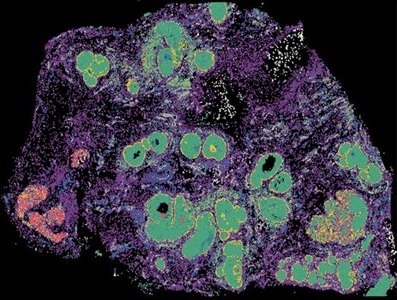
Representative image highlighting different microenvironment cell types surrounding the ducts with preinvasive breast cancer cells. Credit: The Navin Lab/The University of Texas MD Anderson Cancer Center
Researchers at The University of Texas MD Anderson Cancer Center have created one of the most detailed maps to date of the cell environment surrounding ductal carcinoma in situ (DCIS), the most common form of preinvasive, or stage 0, breast cancer.
The findings may help explain why some lesions progress to invasive breast cancer and others do not, informing strategies to improve patient risk prediction and develop better targeted approaches for patients at higher risk of invasive disease.
In the study, published in Science, researchers used advanced single-cell and spatial profiling technologies to map more than 850,000 cells from samples of normal breast tissue, DCIS and invasive breast cancer. They identified extensive changes in cancer cells and the surrounding microenvironment as disease progressed. The detailed atlas suggests that important biological features associated with invasive breast cancer begin to emerge earlier than previously known.
The study also uncovered previously unknown “cancer stromal loops,” ring-like structures made of supportive tissue and vascular cells that surround DCIS lesions, which create conditions that support tumor growth.
“DCIS is considered a snapshot before breast cancer becomes invasive, but not all DCIS cases progress to invasive disease, and the biology surrounding these lesions has been challenging to examine,” said lead study author Nicholas Navin, chair of Systems Biology at the University of Texas MD Anderson Cancer Center. “This atlas reveals the surrounding cells and structures that may help disease become invasive. In the future, these findings may allow clinicians to better identify and treat patients with DCIS who are at higher risk of invasive progression while also avoiding unnecessary treatments for those at low risk.”
Additional research is needed to validate the findings and evaluate their potential use in future diagnostic tools and prevention or treatment strategies.
The researchers said they will continue studying the cellular features identified in this atlas to determine whether they can predict which DCIS lesions are most likely to become invasive.
Data from The University of Texas MD Anderson Cancer Center